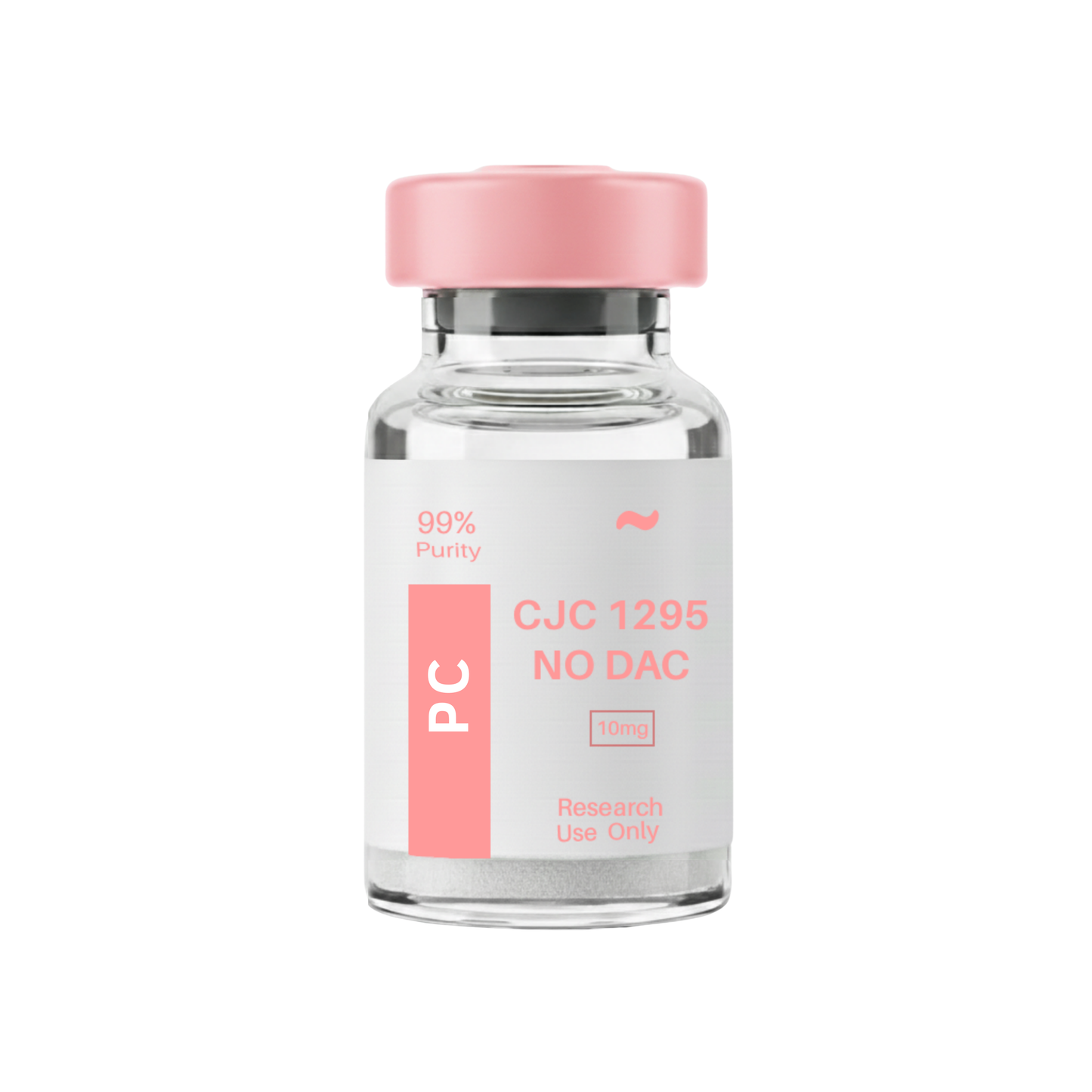
CJC-1295 (No DAC)
CJC-1295 (No DAC)
This batch of CJC-1295 (No DAC) Modified GRF Peptide has been third party lab tested and verified for quality.
Contents: CJC-1295 No DAC
Form: Powder
Purity: 99.0%
Couldn't load pickup availability
Free Reconstitution Solution automatically added to your cart with each order.
This product is Made, Tested & Shipped From Canada.
Ships Today
Order by 1:00 PM EST
Free Shipping
For 2 or more vials
Verified+

CJC-1295 (No DAC)
CJC-1295 (No DAC) is a synthetic analog of growth hormone–releasing hormone (GHRH), comprising 30 amino acids. It selectively activates GHRH receptors on pituitary somatotrophs, eliciting pulsatile secretion of growth hormone (GH) and promoting a downstream increase in insulin-like growth factor 1 (IGF-1). The “No DAC” designation signifies that this peptide does not contain a Drug Affinity Complex (DAC) component, resulting in a shorter biological half-life and short, controllable GH pulses instead of prolonged elevation.
This pharmacological profile makes CJC-1295 (No DAC) valuable for research on GH/IGF-1 axis regulation, physiologic pulsatile hormone signaling, anabolic pathways, and tissue-regeneration mechanisms.
CJC-1295 (No DAC) Overview
CJC-1295 (No DAC) is based on the endogenous GHRH(1–29) sequence and contains four targeted amino acid substitutions at positions 2, 8, 15, and 27. These modifications increase the peptide’s resistance to enzymatic degradation and enhance structural stability while retaining physiologic receptor-binding affinity.
Because it is not linked to a DAC moiety, CJC-1295 (No DAC) has a relatively brief plasma half-life and supports GH release in discrete pulses that closely approximate natural endocrine rhythms. This profile is particularly advantageous for experimental protocols that require modeling of physiologic GH dynamics and assessment of short-lived anabolic and metabolic effects.
In laboratory studies, CJC-1295 (No DAC) is frequently paired with growth hormone secretagogues (GHS) such as Ipamorelin or other GHRPs. This combination approach allows investigators to examine synergistic GH-axis activation and explore effects on metabolism, tissue repair, and body composition under defined research conditions.
CJC-1295 (No DAC) Structure
CJC-1295 (No DAC) Research
Growth Hormone Stimulation and Mechanism of Action
CJC-1295 (No DAC) is an engineered analog of GHRH(1–29) designed to retain strong receptor activation while resisting proteolytic degradation. The four substituted residues maintain high binding affinity for GHRH receptors on pituitary somatotrophs, thereby enhancing the physiologic pulsatile secretion of GH.
In contrast to DAC-conjugated CJC-1295 or other sustained-release agonists that maintain elevated GH for extended intervals, the No DAC form produces sharp GH pulses that are more closely aligned with normal endocrine patterns. This pulsatility helps minimize receptor downregulation and excessive negative feedback associated with continuous GH exposure. Preclinical data consistently demonstrate a dose-dependent increase in GH and IGF-1, providing a well-controlled platform for investigation of anabolic and metabolic pathways.
Metabolic and Body Composition Research
Studies involving CJC-1295 (No DAC) have demonstrated increases in serum GH and IGF-1, which are central regulators of lipid metabolism, lean body mass, and nutrient partitioning. These effects underpin research on reducing fat mass, improving nitrogen retention, and preserving lean tissue across metabolic models.
In combination with GHS such as Ipamorelin or GHRP-6, CJC-1295 (No DAC) has been observed to amplify GH pulse amplitude and frequency. These dual-peptide regimens are used to explore mechanisms of energy expenditure, glucose handling, mitochondrial function, and cellular repair, particularly in studies of metabolic health, recovery from exercise or injury, and age-associated muscle loss.
Neurological and Regenerative Research Applications
The GH/IGF-1 axis also plays an important role in the central nervous system, contributing to neurogenesis, synaptic plasticity, and neural repair. CJC-1295 (No DAC) has been utilized in experimental models to examine its influence on neuronal proliferation, glial modulation, and microvascular remodeling—processes that impact cognitive performance and neural recovery following damage.
Because GH and IGF-1 are involved in connective-tissue remodeling, collagen production, and angiogenesis, CJC-1295 (No DAC) is relevant for regenerative research examining wound healing, orthopaedic tissue repair, and functional recovery post-injury. Its preservation of physiologic GH pulsing enables detailed investigation of these processes without confounding, long-lasting GH elevation.
Pharmacokinetic Properties and Research Advantages
Pharmacokinetically, CJC-1295 (No DAC) differs significantly from DAC-linked CJC-1295. Whereas DAC conjugation confers prolonged half-life via albumin binding, the No DAC peptide circulates freely and is cleared from plasma in a shorter time frame.
This rapid clearance provides fine temporal control over GH stimulation, allowing researchers to schedule dosing and sampling precisely to evaluate acute hormone responses, receptor sensitivity, and feedback regulation. Consequently, CJC-1295 (No DAC) is ideally suited for pulse-based GH experiments, receptor-sensitivity characterizations, and high-resolution metabolic-response studies.
Summary and Research Use Notice
CJC-1295 (No DAC) is a research-use peptide intended to support studies of GH pulsatility, IGF-1 regulation, and associated anabolic and regenerative signaling pathways. Its uses span metabolic research, neuroregeneration, connective-tissue biology, and endocrine pharmacology.
CJC-1295 (No DAC) is provided strictly for laboratory and scientific research. It is not intended for human or veterinary administration, diagnosis, therapeutic application, or consumption.
Article Author
This literature review was compiled and edited by Dr. Cyrill Y. Bowers, Ph.D., an endocrinologist and peptide biochemist known for his pioneering work on growth hormone–releasing peptides (GHRPs). His investigations elucidated how GHRH analogs and GHRPs interact to potentiate pituitary GH secretion, forming the scientific basis for current GH secretagogue and analog research. Over many years, Dr. Bowers has made significant contributions to our understanding of hypothalamic–pituitary regulation and GH-axis–mediated interventions.
Scientific Journal Author
Dr. Cyrill Y. Bowers has concentrated his research career on growth hormone–releasing factors, their receptor signaling, and their cooperative actions with GHRH analogues. Collaborative work with L.A. Frohman, C.J. Strasburger, E.E. Müller, and others has helped define GH/IGF-1 physiology, pulsatile hormone patterns, and endocrine feedback dynamics.
His influential publication, “Discovery of Growth Hormone–Releasing Peptides” (Endocrine Reviews, 1998; 19(6):801–822), remains a key reference in the field of GH secretagogues.
This acknowledgment is intended solely to recognize the scientific achievements of Dr. Bowers and collaborators. Montreal Peptides Canada has no affiliation, sponsorship, or professional association with Dr. Bowers or any researchers cited.
Reference Citations
- Teichman SL, et al. CJC-1295, a long-acting GHRH analog: safety and pharmacokinetics. J Clin Endocrinol Metab. 2006;91(3):799–805. https://pubmed.ncbi.nlm.nih.gov/16352683/
- Frohman LA, et al. Growth hormone-releasing hormone: discovery and clinical relevance. Endocr Rev. 2000;21(1):1-47. https://pubmed.ncbi.nlm.nih.gov/10696565/
- Lapierre H, et al. CJC-1295 increases plasma IGF-1 in primate studies. Endocrinology. 2005;146(6):3052-3058. https://pubmed.ncbi.nlm.nih.gov/15746190/
- Pihoker C, et al. Growth hormone dynamics and feedback regulation. J Clin Endocrinol Metab. 1998;83(10):3417-3421. https://pubmed.ncbi.nlm.nih.gov/9768658/
- Bowers CY. Discovery of growth hormone-releasing peptides. Endocr Rev. 1998;19(6):801-822. https://pubmed.ncbi.nlm.nih.gov/9861543/
- Müller EE, et al. Hypothalamic control of GH secretion. Physiol Rev. 1999;79(2):511-607. https://pubmed.ncbi.nlm.nih.gov/10221987/
- Popovic V, et al. GH secretagogues and GHRH analogs in clinical research. J Endocrinol Invest. 2003;26(9):872-881. https://pubmed.ncbi.nlm.nih.gov/14628911/
- Jansson JO, et al. Pulsatile GH release and experimental regulation. Endocr Rev. 1985;6(2):128-150. https://pubmed.ncbi.nlm.nih.gov/2861011/
- Strasburger CJ, et al. GH and IGF-1 actions in tissue repair. Growth Horm IGF Res. 2000;10(Suppl B):S6-S8. https://pubmed.ncbi.nlm.nih.gov/10984265/
- Bowers CY, et al. Synergistic GH release with GHRH analogs and GHS peptides. J Clin Endocrinol Metab. 1990;70(4):975-982. https://pubmed.ncbi.nlm.nih.gov/2318961/
STORAGE
Storage Instructions
All products are produced using a lyophilization (freeze-drying) process, which preserves peptide stability during shipping for approximately 3–4 months.
After reconstitution with bacteriostatic water, peptides must be stored in a refrigerator to maintain their effectiveness. Once in solution, they generally remain stable for up to 30 days.
Lyophilization, or cryodesiccation, is a specialized dehydration technique in which peptides are frozen and exposed to low pressure. This causes water to sublimate directly from solid to gas, leaving a stable, white crystalline lyophilized peptide that can be stored at room temperature until it is reconstituted with bacteriostatic water.
For extended storage over several months to years, peptides should be kept in a freezer at -80°C (-112°F). Freezing at this temperature helps preserve structural integrity and ensures long-term stability.
Upon receipt, peptides should be kept cool and protected from light. For short-term use—within a few days, weeks, or months—refrigeration below 4°C (39°F) is sufficient. Lyophilized peptides typically remain stable at room temperature for several weeks, making this acceptable for shorter pre-use storage.
Best Practices For Storing Peptides
Correct storage is critical to maintaining peptide stability and ensuring reliable experimental results. Adhering to proper procedures reduces contamination, oxidation, and degradation, thereby extending peptide lifespan. Although some peptides are more prone to breakdown than others, best practices can significantly enhance their long-term stability.
Upon arrival, peptides should be promptly cooled and shielded from light. For short-term use—from several days up to several months—refrigeration below 4°C (39°F) is appropriate. Lyophilized peptides usually remain stable at room temperature for several weeks, which is acceptable for limited storage durations.
For long-term preservation lasting months to years, peptides should be stored at -80°C (-112°F). These ultra-low temperatures offer optimal protection against structural degradation.
Minimize freeze–thaw cycles, as repeated temperature shifts accelerate peptide breakdown. Frost-free freezers, which undergo periodic warming during defrost cycles, should be avoided because they may compromise stability.
Preventing Oxidation and Moisture Contamination
To maintain peptide stability, protect them from air and moisture. Moisture contamination is particularly likely when vials are removed from the freezer. To avoid condensation on the peptide or inside the container, always allow the vial to reach room temperature before opening.
Limit exposure to air by keeping vials closed as much as possible and resealing them promptly after use. When feasible, store remaining peptide under a dry, inert gas such as nitrogen or argon to reduce oxidation. Peptides containing cysteine (C), methionine (M), or tryptophan (W) are especially vulnerable to oxidative degradation and should be handled with additional care.
To preserve long-term integrity, avoid frequent thawing and refreezing. Dividing peptides into small aliquots for individual experiments is an effective strategy to minimize repeated exposure to air and temperature fluctuations.
Storing Peptides In Solution
Peptides in solution have a significantly shorter shelf life than lyophilized forms and are more susceptible to bacterial contamination and chemical degradation. Peptides containing cysteine (Cys), methionine (Met), tryptophan (Trp), aspartic acid (Asp), glutamine (Gln), or N-terminal glutamic acid (Glu) often degrade more rapidly when stored in solution.
If solution storage is necessary, peptides should be prepared in sterile buffers with a pH between 5 and 6. The solution should be aliquoted to limit freeze–thaw events. Under refrigeration at 4°C (39°F), most peptide solutions remain stable for up to 30 days, while more labile peptides should be stored frozen when not in immediate use.
Peptide Storage Containers
Peptide storage containers must be clean, durable, chemically resistant, and appropriately sized to limit excess headspace. Both glass and plastic vials are suitable. Plastic vials are typically made of polystyrene or polypropylene: polystyrene provides high clarity but limited chemical resistance, whereas polypropylene offers greater chemical resistance but is usually translucent.
High-quality glass vials provide excellent clarity, chemical inertness, and stability, making them ideal for long-term storage. However, peptides are often shipped in plastic containers to minimize the risk of breakage. If necessary, peptides can be transferred safely between glass and plastic vials, provided handling is careful and contamination is avoided.
Peptide Storage Guidelines: General Tips
To maintain peptide stability and prevent degradation:
- Store peptides in a cool, dry, and dark environment.
- Avoid repeated freeze–thaw cycles that can damage peptide structure.
- Minimize exposure to air to reduce oxidation.
- Protect peptides from light, which can cause structural changes.
- Prefer lyophilized storage for long-term use; avoid storing peptides in solution for extended periods.
- Aliquot peptides according to experimental needs to limit unnecessary handling and exposure.
-

HIGHEST QUALITY PEPTIDES
Our products are scientifically formulated and manufactured in cGMP-compliant facilities.
-

FAST DELIVERY
Enjoy fast and reliable 3–5 day shipping.
-

Dedicated Customer Service
Our customer service team is highly knowledgeable in peptide research and its applications. We’re available 24/7 to assist you.
You may also like
-
SAVE 23%HCG - Research Grade Peptide Hormone
Regular price From $72.00Regular price From $72.00 Sale priceUnit price / per$94.0023% -
SAVE 25%Tirzepatide
Regular price From $50.00Regular price From $50.00 Sale priceUnit price / per$67.0025% -
SAVE 24%Thymosin Alpha-1
Regular price From $79.00Regular price From $79.00 Sale priceUnit price / per$104.0024% -
SAVE 23%Tesamorelin
Regular price From $80.00Regular price From $80.00 Sale priceUnit price / per$105.0023% -
SAVE 23%Survodutide
Regular price $299.00Regular price $299.00 Sale priceUnit price / per$392.0023% -
SAVE 26%Sterile Water
Regular price From $14.00Regular price From $14.00 Sale priceUnit price / per$19.0026% -
SAVE 23%SLU-PP-332
Regular price $125.00Regular price $125.00 Sale priceUnit price / per$164.0023% -
SAVE 23%Sermorelin
Regular price From $70.00Regular price From $70.00 Sale priceUnit price / per$92.0023% -
SAVE 23%Semaglutide
Regular price From $36.00Regular price From $36.00 Sale priceUnit price / per$47.0023% -
SAVE 23%Retatrutide Triple Agonist
Regular price From $90.00Regular price From $90.00 Sale priceUnit price / per$118.0023% -
SAVE 26%Oxytocin Acetate
Regular price $42.00Regular price $42.00 Sale priceUnit price / per$57.0026% -
SAVE 25%Melanotan II (MT2)
Regular price $50.00Regular price $50.00 Sale priceUnit price / per$67.0025% -
SAVE 24%Lipo-C with B Vitamins
Regular price $85.00Regular price $85.00 Sale priceUnit price / per$112.0024% -
SAVE 23%L-Carnitine
Regular price $97.00Regular price $97.00 Sale priceUnit price / per$127.0023% -
SAVE 23%Lemon Bottle 10mg
Regular price $80.00Regular price $80.00 Sale priceUnit price / per$105.0023% -
SAVE 24%KPV Tripeptide
Regular price From $56.00Regular price From $56.00 Sale priceUnit price / per$74.0024% -
KLOW Blend - GHK-CU + TB-500 + BPC-157 + KPV 10mg
Regular price $200.00Regular price $200.00 Sale priceUnit price / per$261.0023% -
Kisspeptin-10 - Premium Research Peptide
Regular price From $65.00Regular price From $65.00 Sale priceUnit price / per$85.0023% -
SAVE 23%Ipamorelin
Regular price From $32.00Regular price From $32.00 Sale priceUnit price / per$42.0023% -
SAVE 24%IGF-1 LR3 (Long R3)
Regular price From $40.00Regular price From $40.00 Sale priceUnit price / per$53.0024% -
SAVE 24%HMG 75iu - Premium Research Peptide
Regular price $80.00Regular price $80.00 Sale priceUnit price / per$106.0024% -
SAVE 24%Hyaluronic
Regular price $28.00Regular price $28.00 Sale priceUnit price / per$37.0024% -
SAVE 23%HGH Fragment 176-191
Regular price $97.00Regular price $97.00 Sale priceUnit price / per$127.0023% -
SAVE 23%HGH 191AA (Somatropin)
Regular price From $55.00Regular price From $55.00 Sale priceUnit price / per$72.0023% -
SAVE 23%HCG - Premium Research Peptide
Regular price From $72.00Regular price From $72.00 Sale priceUnit price / per$94.0023% -
Gonadorelin - Premium Research Peptide
Regular price $50.00Regular price $50.00 Sale priceUnit price / per$67.0025% -
SAVE 23%Glutathione
Regular price From $75.00Regular price From $75.00 Sale priceUnit price / per$98.0023% -
SAVE 23%Glow BPC-157 + GHK-CU + TB-500
Regular price $139.00Regular price $139.00 Sale priceUnit price / per$181.0023%
Every vial we sell comes from a lab that follows current Good Manufacturing Practices (cGMP). That means each step of production is documented and controlled. Before a batch is released, it’s tested by independent third-party labs for purity, identity, and sterility. Certificates of analysis are available so you can see the exact test results.
Yes. The labs we work with use ISO-certified clean rooms where air quality, equipment, and handling procedures are tightly regulated. Staff are trained to pharmaceutical-grade standards. This ensures the peptides are produced in an environment that minimizes contamination risks.
Peptides in lyophilized (freeze-dried) form are stable at room temperature for transport. Once you receive them, refrigeration is recommended to maintain long-term integrity. We package every order securely to prevent damage and ship promptly, so your vials arrive in optimal condition.
We operate under strict in-house protocols that follow current Good Manufacturing Practices (cGMP). That means our team oversees the entire process from sourcing raw amino acids to the final lyophilized vial. Nothing is outsourced or repackaged. This gives us full control over purity, consistency, and sterility, and it’s why we can stand behind every single vial we ship.
Store them in the refrigerator, away from direct light and heat. If you need to keep them longer, some peptides can be stored frozen. Each vial comes with clear handling instructions so you know the proper conditions for stability.
The strongest proof is transparency. For every peptide, we can provide certificates of analysis, manufacturing documentation, and references to the published scientific research behind it. If you ever have questions, we’ll show you the data rather than ask you to take our word for it.
The difference is transparency. Most sites give you a product name and a price. We provide full batch testing, lab documentation, and direct access to certificates of analysis so you don’t have to guess what you’re getting. When you order from us, you know exactly what’s in the vial, where it was made, and how it was verified.