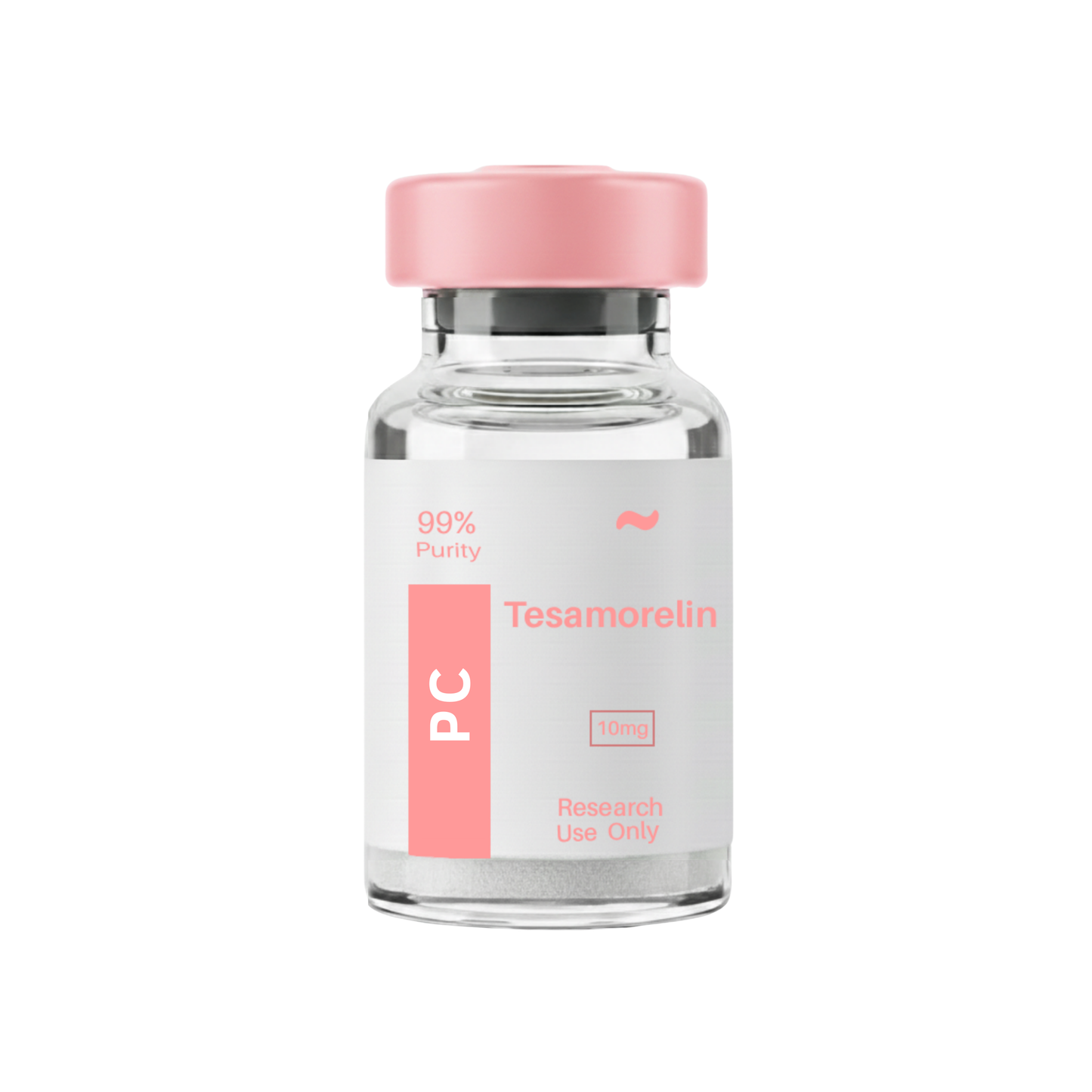
Tesamorelin Peptide
Tesamorelin is a scientifically advanced, synthetic analog of Growth Hormone-Releasing Hormone (GHRH), specifically designed to maximize stability and biological longevity. It acts as a potent and selective agonist, binding with high affinity to human GHRH receptors situated in the anterior pituitary gland, thereby mirroring and enhancing the function of the natural hormone. Research confirms Tesamorelin's effectiveness in achieving significant systemic increases in Insulin-like Growth Factor 1 (IGF-1) concentrations, with data showing an average increase of 181 micrograms per liter in male research subjects.
Beyond its primary role in stimulating the somatotropic axis, Tesamorelin has shown promise in several complex research domains:
- Cardiometabolic Markers: Demonstrated reductions in visceral adipose tissue (VAT), lowered triglyceride levels, and decreased inflammatory markers such as C-reactive protein (CRP).
- Vascular Structure: Research indicates an ability to reduce carotid intima-media thickness (cIMT).
- Neurocognitive Function: Explored for potential nootropic effects, particularly in research focused on mitigating cognitive decline in older adults and subjects with mild cognitive impairment who are at risk for conditions like Alzheimer's disease.
Crucially, Tesamorelin's action is highly specific, and studies suggest it does not significantly interfere with the production or regulation of other essential hormones originating from the pituitary gland.
Tesamorelin Peptide Overview
Mechanism of Action
Tesamorelin initiates its activity by specifically targeting and activating GHRH receptors located on the somatotroph cells within the anterior pituitary gland. This targeted agonism powerfully promotes the enhanced, pulsatile secretion of Growth Hormone (GH). GH then stimulates the liver and other tissues to produce and secrete Insulin-like Growth Factor 1 (IGF-1), the primary mediator of GH's anabolic (growth-promoting) and anti-apoptotic effects. GH itself is known for its strong lipolytic properties, facilitating the breakdown and mobilization of fat, particularly in the critical visceral and abdominal fat depots.
The intracellular signaling cascade triggered by Tesamorelin is understood to involve:
- Enzyme Activation: Binding to the GHRH receptor is hypothesized to activate adenylate cyclase, which catalyzes the conversion of ATP into the vital secondary messenger, cyclic AMP (cAMP).
- Signal Amplification: The resulting elevated intracellular cAMP levels activate Protein Kinase A (PKA), initiating a cascade of signal transduction events crucial for hormone synthesis and release.
This combined pathway significantly boosts GH secretion. Studies indicate that this process results in an approximately 69% increase in total GH exposure (AUC) and a 55% increase in mean pulse area, while preserving the natural rhythm of GH pulses. This enhanced GH activity corresponds to a reported increase of approximately 122% in circulating IGF-1 levels.
Product Structure
Tesamorelin is a synthetic peptide containing 44 amino acids, distinguished by specific structural modifications that enhance its stability and resistance to systemic proteolytic degradation (enzymatic breakdown). These strategically placed modifications occur at both terminal ends:
- C-terminus Modification: Features a trans-3-hexenoyl group, a specific lipid modification that shields the peptide from rapid enzymatic cleavage.
- N-terminus Modification: Incorporates an acetyl (CH3CO) group, which is known to be critical for improving the peptide's overall stability and maintaining high biological activity.
The standardized chemical identification for Tesamorelin is: N-(trans-3-hexenoyl)-[Tyr 1]hGHRF(1-44)NH2 acetate.
Tesamorelin Research
Extensive clinical trials and research studies have explored the impact of Tesamorelin across various metabolic and structural endpoints.
Research Focus
Study Design and Context
Key Research Findings
Visceral Adipose Tissue (VAT) Reduction
Pooled analysis of two Phase III clinical trials over 26 weeks in subjects with HIV-associated lipodystrophy.
Demonstrated a significant reduction in VAT, achieving a minimum decrease of 15.4%. Concurrent reductions were also observed in circulating triglyceride and cholesterol levels compared to placebo.
Hepatic Fat Fraction (HFF) / NAFLD Research
12-month clinical investigation involving 61 HIV-positive participants with elevated HFF (a key marker of liver fat).
35% of the Tesamorelin-treated group achieved a measurable HFF reduction of less than 5%, a statistically superior result compared to the 4% seen in the placebo group. No significant alterations in blood glucose levels were recorded.
Skeletal Muscle Composition
Evaluation using Computed Tomography (CT) imaging to assess changes in muscle quality in adults with HIV.
Showed statistically significant improvements in composition in specific muscle groups (e.g., rectus abdominis, psoas major, paraspinal muscles), including increases in muscle density and size or reductions in intramuscular fat content compared to controls.
Cognitive Function (Ongoing Trial)
Phase II clinical investigation (100 immunodeficient subjects over 40) examining neurological outcomes over a 12-month period.
The study is actively evaluating the change in the Global Deficit Score as the primary endpoint at 6 and 12 months. Final data are pending publication.
Insulin Sensitivity (Type 1 Diabetes)
12-week randomized clinical trial with 53 participants with Type 1 Diabetes.
No statistically significant differences were observed between the treatment and placebo groups for changes in fasting glucose, HbA1c levels, or required daily insulin dosage, suggesting a neutral effect on insulin sensitivity under these conditions.
Reference Citations
Clinical and Research Information on Drug-Induced Liver Injury [Internet]. Bethesda (MD): National Institute of Diabetes and Digestive and Kidney Diseases; 2012-. Tesamorelin. [Updated 2018 Oct 20]. https://www.ncbi.nlm.nih.gov/books/NBK548730/
Spooner, L. M., & Olin, J. L. (2012). Tesamorelin: a growth hormone-releasing factor analogue for HIV-associated lipodystrophy. The Annals of pharmacotherapy, 46(2), 240-247. https://doi.org/10.1345/aph.10629
Stanley TL, Chen CY, Branch KL, Makimura H, Grinspoon SK. Effects of a growth hormone-releasing hormone analog on endogenous GH pulsatility and insulin sensitivity in healthy men. J Clin Endocrinol Metab. 2011 Jan;96(1):150-8. doi: 10.1210/jc.2010-1587. Epub 2010 Oct 13. PMID: 20943777; PMCID: PMC3038486. https://www.ncbi.nlm.nih.gov/pmc/articles/PMC3038486/
Ferdinandi ES, Brazeau P, High K, Procter B, Fennell S, Dubreuil P. Non-clinical pharmacology and safety evaluation of TH9507, a hu- man growth hormone-releasing factor analogue. Basic Clin Pharmacol Toxicol. 2007 Jan;100(1):49-58. doi: 10.1111/j.1742- 7843.2007.00008.x. PMID: 17214611. https://pubmed.ncbi.nlm.nih.gov/17214611/
Stanley, T. L., Fourman, L. T., Feldpausch, M. N., Purdy, J., Zheng, I., Pan, C. S., Aepfelbacher, J., Buckless, C., Tsao, A., Kellogg, A., Branch, K., Lee, H., Liu, C. Y., Corey, K. E., Chung, R. T., Torriani, M., Kleiner, D. E., Hadigan, C. M., & Grinspoon, S. K. (2019). Effects of tesamorelin on non-alcoholic fatty liver disease in HIV: a randomised, double-blind, multicentre trial. The lancet. HIV, 6(12), e821- e830. https://www.ncbi.nlm.nih.gov/pmc/articles/PMC6981288/
Falutz J, Mamputu JC, Potvin D, Moyle G, Soulban G, Loughrey H, Marsolais C, Turner R, Grinspoon S. Effects of tesamorelin (TH9507), a growth hormone-releasing factor analog, in human immunodeficiency virus-infected patients with excess abdominal fat: a pooled analysis of two multicenter, double-blind placebo-controlled phase 3 trials with safety extension data. J Clin Endocrinol Metab. 2010 Sep;95(9):4291-304. doi: 10.1210/jc.2010-0490. Epub 2010 Jun 16. PMID: 20554713. https://pubmed.ncbi.nlm.nih.gov/20554713/
Tesamorelin Effects on Liver Fat and Histology in HIV. https://clinicaltrials.gov/ct2/show/NCT02196831
Phase II Trial of Tesamorelin for Cognition in Aging HIV-Infected Persons. https://clinicaltrials.gov/ct2/show/record/NCT02572323
Clemmons, D. R., Miller, S., & Mamputu, J. C. (2017). Safety and metabolic effects of tesamorelin, a growth hormone-releasing factor analogue, in patients with type 2 diabetes: A randomized, placebo-controlled trial. PloS one, 12(6), e0179538. https://www.ncbi.nlm.nih. gov/pmc/articles/PMC5472315/
Adrian S, Scherzinger A, Sanyal A, Lake JE, Falutz J, Dubé MP, Stanley T, Grinspoon S, Mamputu JC, Marsolais C, Brown TT, Erlandson KM. The Growth Hormone Releasing Hormone Analogue, Tesamorelin, Decreases Muscle Fat and Increases Muscle Area in Adults with HIV. J Frailty Aging. 2019;8(3):154-159. doi: 10.14283/jfa.2018.45. PMID: 31237318; PMCID: PMC6766405. https://www.ncbi.nlm.nih.gov/pmc/ articles/PMC6766405/
Sivakumar T, Mechanic O, Fehmie DA, Paul B. Growth hormone axis treatments for HIV-associated lipodystrophy: a systematic review of placebo-controlled trials. 12. HIV Med. 2011 Sep;12(8):453-62. doi: 10.1111/j.1468-1293.2010.00906.x. Epub 2011 Jan 25. PMID: 21265979.
ALL ARTICLES AND PRODUCT INFORMATION PROVIDED ON THIS WEBSITE ARE FOR INFORMATIONAL AND EDUCATIONAL PURPOSES ONLY.
The products offered on this website are furnished for in-vitro studies only. In-vitro studies (Latin: in glass) are performed outside of the body. These products are not medicines or drugs and have not been approved by the FDA to prevent, treat or cure any medical condition, ailment or disease. Bodily introduction of any kind into humans or animals is strictly forbidden by law.
Storage
Storage Instructions
Tesamorelin is delivered in its most stable form: a lyophilized (freeze-dried) powder. This specialized dehydration process, known as cryodesiccation, creates a crystalline structure that maintains integrity for approximately three to four months during shipping.
Key storage conditions for this research peptide include:
- Upon Receipt: The peptide must be kept cool and shielded from light.
- Short-Term Storage (Days to Months): Refrigeration at temperatures below 4 degrees C (39 degrees F) is suitable. The lyophilized powder is generally stable at room temperature for several weeks, acceptable for very brief storage.
- Long-Term Storage (Months to Years): For optimal, multi-year preservation of structural integrity, storage in an ultra-low freezer at -80 degrees C (-112 degrees F) is the best practice.
Following reconstitution with bacteriostatic water, the peptide solution must be stored in a refrigerator. The solution typically remains stable for a period of up to 30 days.
Best Practices for Storing Peptides
Rigorous adherence to storage protocols is vital for achieving reliable and reproducible experimental results. Correct procedures minimize contamination, oxidation, and structural degradation.
- Avoid Thermal Stress: Minimize repeated freeze-thaw cycles, which rapidly accelerate degradation. Avoid frost-free freezers for long-term storage due to the destabilizing temperature fluctuations during their automated defrost cycles.
- Aliquoting: To prevent the entire stock from being subjected to multiple handling events and temperature changes, divide the total peptide into smaller, single-use aliquots immediately upon receipt.
Preventing Oxidation and Moisture Contamination
Exposure to moisture and air (oxygen) significantly compromises peptide stability. Peptides with oxidation-prone residues, such such as cysteine (C), methionine (M), or tryptophan (W), require extra protective measures.
- Moisture Control: Always allow the peptide vial to reach room temperature before opening when retrieving it from cold storage. This prevents atmospheric moisture from condensing inside the vial.
- Oxidation Control: Keep the container sealed as much as possible. After dispensing, promptly reseal the vial. Storing the remaining peptide under a dry, inert gas atmosphere (e.g., nitrogen or argon) can provide superior protection against oxidation.
Storing Peptides in Solution
Peptide solutions have a notably shorter shelf life and are far more susceptible to chemical and microbial degradation than the lyophilized powder. Peptides containing residues like cysteine (Cys), methionine (Met), tryptophan (Trp), aspartic acid (Asp), glutamine (Gln), or N-terminal glutamic acid (Glu) exhibit faster degradation in solution.
- Optimal Buffer: If storage in solution is necessary, use sterile buffers with a value between 5 and 6. Aliquoting the solution is still recommended to reduce freeze-thaw events.
- Solution Stability: Most solutions, when stored under refrigeration at 4 degrees C (39 degrees F), remain stable for up to 30 days. Highly sensitive peptides should be kept frozen when not in immediate use.
Peptide Storage Guidelines: General Tips
- Store peptides in a cold, dry, and dark environment.
- Avoid repeated freeze-thaw cycles.
- Minimize air exposure to reduce the risk of oxidation.
- Protect from light.
- Store in lyophilized form for long-term preservation.
- Aliquot peptides to limit stock handling.