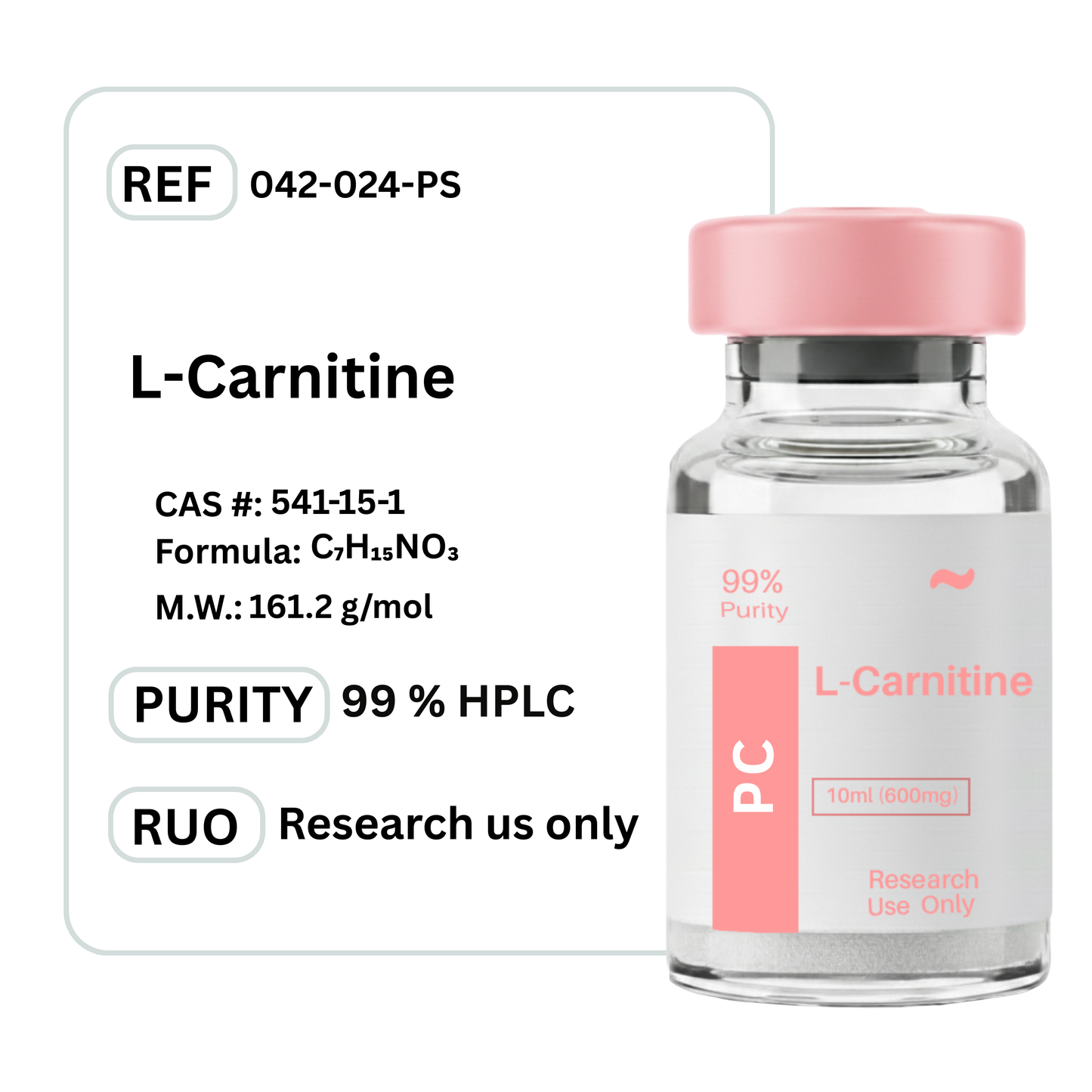
L-Carnitine Solution
L-Carnitine is a naturally occurring quaternary ammonium compound fundamental to energy generation. It plays a critical role in the transport of long-chain fatty acids into the mitochondria, the key cellular sites for energy production. This molecule acts as an essential cofactor in mitochondrial metabolism, enabling the oxidation of these fatty acids and thereby supporting the synthesis of ATP, the cell’s universal energy currency.
The compound is naturally synthesized from the amino acids lysine and methionine, and it is also obtained through the diet, primarily from meat and dairy products. Ongoing scientific research continues to detail its broad physiological importance, specifically in metabolic regulation, supporting muscle function, contributing to cardiovascular health, and its potential neuroprotective effects in various research models.
L-Carnitine Solution -10 ml (600mg) Overview
L-Carnitine functions as a vital transport shuttle, necessary for the passage of long-chain fatty acids into the mitochondrial matrix by forming reversible acyl-carnitine esters. This transport across the inner mitochondrial membrane is the mandatory step for initiating beta-oxidation, the metabolic pathway responsible for breaking down fatty acids into energy. Its functional importance is maximized in tissues with high energy demand, such as skeletal muscle, the myocardium, and the liver, where efficient and continuous energy metabolism is paramount.
In addition to its central role in fat metabolism, experimental evidence suggests that L-Carnitine acts as an antioxidant. It aids in buffering excess acyl-CoA levels and reduces markers of oxidative stress, thereby protecting cells from damage associated with metabolic strain. Through these dual capacities, L-Carnitine is integral to maintaining cellular vitality and metabolic balance in research systems.
Research models have extensively investigated the research utility of L-Carnitine, with studies exploring its possible role in enhancing exercise performance and recovery, cardiac support, modulation of insulin resistance, and support for neurological health in relevant models. Collectively, these findings underscore L-Carnitine's critical and multifaceted involvement in energy flow, defense against oxidation, and overall metabolic resilience.
L-Carnitine Solution Structure
Characteristic
Detail
Molecular Formula
C7H15N03
Molecular Weight
161.2 grams per mole
Structure Name
B-hydroxy-y-trimethylaminobutyric acid
Concentration
60mg/ml (600mg total in 10ml vial)
Known Nomenclature
Levocarnitine, L-3-hydroxy-4-trimethylaminobutyrate
L-Carnitine Solution Research
Research Field
Summary of Findings in Models
Mitochondrial Energy Metabolism
L-Carnitine is essential for mitochondrial fatty acid beta-oxidation, maintaining energy balance during fasting, physical activity, and metabolic challenge. Deficiency models show impaired fatty acid combustion and reduced energy output.
Cardiovascular Function
Evidence suggests L-Carnitine supplementation can enhance cardiac energy efficiency, protect against ischemia-reperfusion injury, and lower oxidative stress markers in heart tissue.
Exercise and Muscle Recovery
Muscle physiology research correlates L-Carnitine use with reduced lactate buildup post-exercise, improved oxygen utilization, and faster muscle recovery rates.
Neurological Models
Acetyl-L-carnitine derivatives are studied for their neuroprotective effects, mitochondrial support, and potential to enhance cognitive function in neurodegenerative disease models.
Insulin Sensitivity and Metabolism
Studies suggest L-Carnitine may improve glucose tolerance and insulin sensitivity by promoting fatty acid oxidation and reducing the accumulation of fat within muscle cells.
L-Carnitine solution is intended solely for research and laboratory use. Not for human consumption.
Article Author
This literature review was compiled, edited, and organized by Dr. Charles J. Rebouche, Ph.D. Dr. Rebouche is a distinguished biochemist recognized for his extensive work on carnitine metabolism, nutrient transport, and mitochondrial fatty acid oxidation. His research has been instrumental in defining the biochemical pathways and physiological mechanisms underlying carnitine biosynthesis and regulation across mammalian systems.
Scientific Journal Author
Dr. Charles J. Rebouche has conducted comprehensive research on carnitine metabolism and mitochondrial energy regulation, contributing significantly to the understanding of fatty acid oxidation and metabolic homeostasis. His findings—together with those of collaborators such as H. Seim, J. Bremer, and C.A. Stanley—have provided key insights into L-Carnitine's biochemical functions, its essential role in mitochondrial transport systems, and its clinical importance in energy metabolism.
Dr. Rebouche is acknowledged as one of the principal contributors to modern L-Carnitine research. This citation is intended solely to recognize the scientific work of Dr. Rebouche and his colleagues. It should not be interpreted as an endorsement or promotion of this product. Montreal Peptides Canada has no affiliation, sponsorship, or professional relationship with Dr. Rebouche or any of the researchers cited.
Reference Citations
ALL ARTICLES AND PRODUCT INFORMATION PROVIDED ON THIS WEBSITE ARE FOR INFORMATIONAL AND EDUCATIONAL PURPOSES ONLY. The products offered on this website are furnished for in-vitro studies only. In-vitro studies (Latin: in glass) are performed outside of the body. These products are not medicines or drugs and have not been approved by the FDA to prevent, treat or cure any medical condition, ailment or disease. Bodily introduction of any kind into humans or animals is strictly forbidden by law.
STORAGE
Storage Instructions
All products are prepared through lyophilization (freeze-drying), a process that ensures stability during shipping for approximately 3-4 months. Upon reconstitution with bacteriostatic water, the peptides must be stored in a refrigerator to maintain their effectiveness. Once in solution, stability is preserved for up to 30 days.
Lyophilization, or cryodesiccation, is a specialized dehydration method where peptides are frozen and exposed to low pressure. This causes the water to sublimate (change directly from solid to gas), leaving behind the stable, white crystalline material known as the lyophilized peptide. This powder is stable at room temperature until reconstitution.
For extended storage periods (several months to years), storage in a freezer at -80 degrees Celsius (-112 degrees Fahrenheit) is highly recommended. This temperature is crucial for preserving the peptide's structural integrity and ensuring long-term stability.
Upon receipt, peptides should be stored in a cool place, protected from light. For short-term use—within a few days, weeks, or months—refrigeration below 4 degrees Celsius (39 degrees Fahrenheit) is suitable. Lyophilized peptides generally remain stable at room temperature for several weeks, acceptable for shorter storage durations.
Best Practices For Storing Peptides
Proper storage is critical for maintaining the accuracy and reliability of research results. Correct procedures minimize contamination, oxidation, and degradation, ensuring peptides remain stable and effective. Applying best practices can significantly extend the lifespan and integrity of peptides.
Upon receipt, store peptides cool and shielded from light. For short-term use, refrigeration below 4 degrees Celsius (39 degrees Fahrenheit) is suitable. Lyophilized peptides remain stable at room temperature for several weeks.
For long-term preservation over several months or years, peptides must be stored in a freezer at -80 degrees Celsius (-112 degrees Fahrenheit). This provides optimal stability and protection against structural degradation.
It is crucial to minimize freeze-thaw cycles, as repeated temperature fluctuations accelerate degradation. Frost-free freezers should be avoided because their automatic defrost cycles cause temperature variations that can compromise stability.
Preventing Oxidation and Moisture Contamination
Protecting peptides from air and moisture is vital. Moisture contamination is a particular risk when removing cold peptides from the freezer. To prevent condensation, always allow the vial to reach room temperature before opening it.
Minimizing air exposure is equally important. The container should remain sealed as much as possible, and promptly reseal it after removing the required amount. Storing the remaining peptide under a dry, inert gas (e.g., nitrogen or argon) can prevent oxidation. Peptides with cysteine (C), methionine (M), or tryptophan (W) residues are highly sensitive to air oxidation and require extra care.
To maintain long-term stability, avoid frequent thawing and refreezing. A practical approach is to divide the total peptide into smaller aliquots, each for a single experimental use, minimizing repeated exposure to air and temperature changes.
Storing Peptides In Solution
Peptide solutions have a significantly shorter shelf life than lyophilized forms and are more vulnerable to bacterial degradation. Peptides containing cysteine (Cys), methionine (Met), tryptophan (Trp), aspartic acid (Asp), glutamine (Gln), or N-terminal glutamic acid (Glu) residues tend to degrade more rapidly when stored in solution.
If solution storage is necessary, use sterile buffers with a pH between 5 and 6. The solution should be aliquoted to minimize freeze-thaw cycles. Under refrigeration at 4 degrees Celsius (39 degrees Fahrenheit), most solutions remain stable for up to 30 days. Unstable peptides should be kept frozen when not in immediate use.
Peptide Storage Containers
Containers must be clean, clear, durable, and chemically resistant. They should be sized appropriately to minimize excess air space. Both glass and plastic vials (polystyrene or polypropylene) are suitable. Polystyrene is clear but less chemically resistant, while polypropylene is more chemically resistant but typically translucent.
High-quality glass vials offer the best overall characteristics (clarity, stability, inertness). Peptides are often shipped in plastic to prevent breakage. Safe transfer between glass and plastic is possible to suit specific needs.
Peptide Storage Guidelines: General Tips
Follow these practices to maintain optimal stability:
- Store peptides in a cold, dry, and dark environment.
- Avoid repeated freeze-thaw cycles.
- Minimize air exposure to prevent oxidation.
- Protect peptides from light.
- Do not store in solution long term; keep them lyophilized if possible.
- Aliquot peptides based on experimental needs.