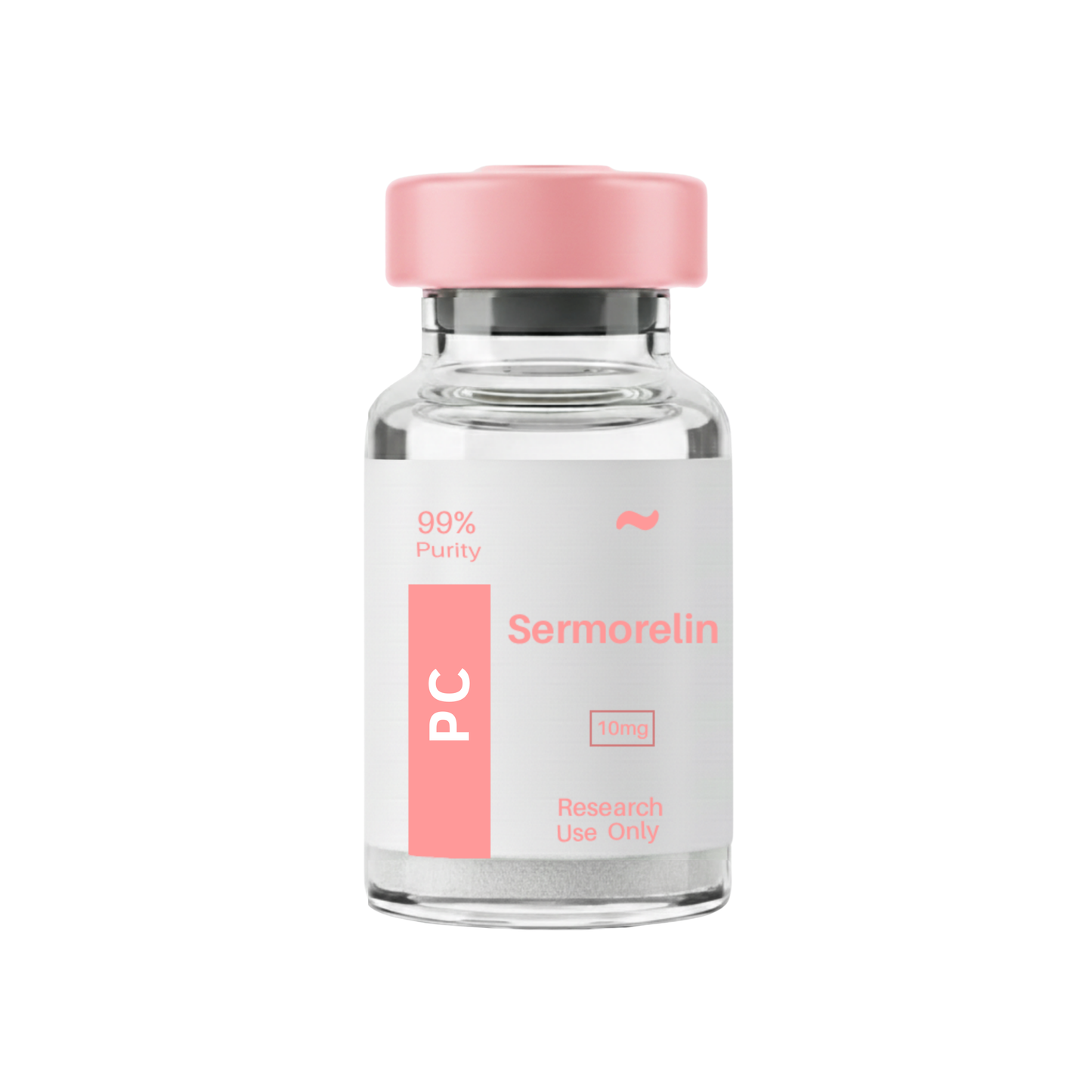
Sermorelin
Sermorelin Acetate is a bio-identical synthetic peptide that corresponds precisely to the 29-amino-acid active N-terminal fragment of the human Growth Hormone-Releasing Hormone (GHRH). It was designed to function as a potent secretagogue, specifically stimulating the pituitary gland to produce and release Growth Hormone (GH). While initially developed for the clinical assessment of GH secretion, extensive academic and preclinical research continues to uncover Sermorelin’s broad potential across multiple biological systems.
Current experimental investigation suggests Sermorelin may be a valuable compound for studying:
- Tissue Anabolism: Enhancing tissue repair, minimizing fibrotic scarring, and supporting recovery following ischemic events, such as myocardial infarction.
- Skeletal Density: Promoting osteogenesis (bone formation) and offering research models for the reversal of age-related declines in bone mineral density.
- Metabolic Support: Investigating its role in mitigating muscle atrophy and improving nutrient metabolism in conditions of chronic catabolism or cachexia.
- Vascular Function: Stimulating the proliferation of new blood vessels (angiogenesis) and supporting vascular health.
- Central Nervous System (CNS) Activity: Exploring its neuroprotective effects, including the potential modulation of neural excitability and cognitive processes.
These findings solidify Sermorelin's standing as a vital research tool for understanding the intricate relationship between endocrine signaling, tissue remodeling, and systemic homeostasis.
Sermorelin Overview
The mechanism of Sermorelin is characterized by its high specificity for the Growth Hormone-Releasing Hormone Receptor (GHRHR) located on the pituitary somatotroph cells. By binding to this receptor, Sermorelin triggers a classic G-protein signaling cascade. This activation leads to the stimulation of adenylyl cyclase, which causes a rapid and significant increase in intracellular levels of cyclic AMP (cAMP).
The rise in cAMP is the primary signal responsible for:
- Increased transcription of the Growth Hormone (GH) gene.
- Facilitating the synthesis and natural, pulsatile release of stored GH into the circulation.
The released GH then travels to target organs, most notably the liver, where it stimulates the production of Insulin-like Growth Factor-1 (IGF-1), the major mediator of GH's growth and anabolic effects.
A significant advantage of Sermorelin in research is its reliance on the body's natural system. This mechanism ensures that the physiological feedback loop, particularly the inhibitory effects of somatostatin, remains intact. By maintaining the integrity of the endogenous GH axis, Sermorelin promotes a more controlled and physiological release pattern than direct exogenous GH, making it ideal for studies on lean mass maintenance, fat distribution, and sleep cycle regulation.
Sermorelin Structure and Specification
Sermorelin is a synthetic oligopeptide, serving as the biologically active N-terminal fragment of human GHRH.
Parameter
Value
Sequence
H-Tyr-Ala-Asp-Ala-Ile-Phe-Thr-Asn-Ser-Tyr-Arg-Lys-Val-Leu-Gly-Gln-Leu-Ser-Ala-Arg-Lys-Leu-Leu-Gln-Asp-Ile-Met-Ser-Arg-NH2
Molecular Formula
C149H248N44O42S
Molecular Weight
3357.933 g/mol
Purity (Typical)
>98% (Assayed by HPLC)
Storage Form
Lyophilized powder
Structure Solution
Sermorelin's molecular structure is C149H248N44O42S. The N-terminus (Tyrosine) is unblocked, and the C-terminus (Arginine) is terminally amidated with an -NH2 group, which increases its stability against enzymatic degradation.
Sermorelin Research
Sermorelin and Myocardial Tissue Repair
Following an ischemic event like a myocardial infarction (heart attack), the heart undergoes a process of cardiac remodeling that often involves detrimental scarring (fibrosis), leading to long-term functional decline and heart failure. Research is focused on interventions that can promote functional tissue healing and minimize fibrosis.
Studies conducted in relevant animal models have demonstrated that Sermorelin administration can significantly limit the progression of adverse cardiac remodeling post-MI. The observed mechanisms of action include:
- Reduction of Cardiomyocyte Loss: Sermorelin helps preserve viable heart muscle cells by reducing apoptosis (programmed cell death).
- Improved Extracellular Matrix (ECM) Quality: It guides the healing process toward the formation of a more organized ECM, which supports heart structure better than simple, dense scar tissue.
- Angiogenesis Promotion: It facilitates the growth of new blood vessels, improving perfusion in the damaged areas.
- Inflammatory Modulation: It acts to decrease harmful, excessive inflammation in the myocardium.
These findings suggest Sermorelin is a valuable compound for researchers studying restorative and cardioprotective strategies.
Neurobiological and Cognitive Research
The involvement of the GHRH axis in CNS function is a growing field of study.
- Anticonvulsant Potential: Research in experimental models of epilepsy has identified that GHRH analogs, including Sermorelin, can exert a significant suppressive effect on seizure activity. This effect is hypothesized to be linked to the modulation of the Gamma-aminobutyric acid (GABA) inhibitory neurotransmitter system. This line of research offers novel targets for the development of alternative anti-seizure compounds.
- Sleep Cycle Interaction: GH release is tightly linked to deep sleep, and the GHRH axis is known to interact with orexin (hypocretin), a neuropeptide central to regulating sleep and wakefulness. Studies show that Sermorelin administration can enhance orexin secretion, supporting its use in research investigating the neuroendocrine basis of sleep disorders and cognitive maintenance.
Why Sermorelin is Preferred Over Growth Hormone
Sermorelin is often the preferred agent over direct, exogenous GH in research designed to modulate GH levels, primarily due to safety and physiological considerations.
- Physiological Regulation: Sermorelin's mechanism ensures GH is released in a natural, pulsatile manner, respecting the pituitary's storage capacity and regulatory feedback systems (like somatostatin). This prevents the high, non-pulsatile levels associated with direct GH injection, which can lead to adverse effects and disruption of the natural endocrine balance.
- Sustained Response: Unlike many direct receptor agonists that cause tolerance (tachyphylaxis), Sermorelin research suggests that continuous use may actually lead to an upregulation (increase in density) of GHRH receptors on the pituitary cells. This unique biological response helps sustain the peptide's effectiveness and avoids the need for dose increases or temporary cessation.
The Sermorelin product provided is strictly for educational and scientific research purposes only and is not approved for use in humans or animals. It must be purchased and handled exclusively by qualified, licensed researchers.
Disclaimer and Author Information
Article Author
The information and documentation provided were meticulously researched, reviewed, and compiled by the Peptide Initiative Research Team. The team is comprised of expert scientific writers and medical researchers specializing in peptide pharmacology, endocrinology, and molecular biology. Their mission is to translate complex, peer-reviewed scientific literature into accurate and accessible educational resources for the research community.
Current research efforts focus on the comprehensive analysis of GHRH analogs, including Sermorelin, CJC-1295, and GHRP-6, covering their mechanisms, experimental applications, and stability profiles.
Scientific Journal Author Acknowledgement
Dr. Ivan J. Clarke, Ph.D., Professor of Neuroendocrinology and Endocrine Physiology at the University of Melbourne, is a globally recognized authority on the GHRH system and pituitary regulation.
Dr. Clarke, in collaboration with Dr. Francesco Camanni and Dr. Ezio Ghigo, conducted foundational studies critical to the understanding and characterization of GHRH analogs, specifically Sermorelin (GHRH 1–29).
These eminent scientists are referenced solely to credit the original, peer-reviewed scientific work that forms the basis of this discussion. They are not affiliated with, nor do they endorse, the sale or use of any product described herein.
Reference Citations
RESEARCH USE ONLY WARNING: ALL ARTICLES AND PRODUCT INFORMATION PROVIDED ON THIS WEBSITE ARE FOR INFORMATIONAL AND EDUCATIONAL PURPOSES ONLY. The products offered are intended solely for in-vitro studies (experiments conducted outside of a living system). These products are not approved as medicines or drugs by the FDA or any other regulatory body for the prevention, treatment, or cure of any medical condition, ailment, or disease. Introduction into humans or animals for any purpose is strictly forbidden by law and is in violation of the intended scientific research use.
Storage and Handling Guidelines
Storage Instructions
Sermorelin is manufactured using the highly effective lyophilization (freeze-drying) process, which guarantees the stability of the peptide during shipping for up to 3–4 months.
- Upon Receipt: The peptide should be kept in a cool, dry, and dark environment. For immediate or short-term use (up to a few months), it should be stored under refrigeration below 4°C (39°F). The lyophilized powder is stable at room temperature for several weeks, making this suitable for very short storage periods.
- Long-Term Preservation: For storage over several months to years, optimal stability is achieved by keeping the peptide in a freezer at -80°C (-112°F). This ultra-cold temperature is essential for preventing molecular degradation.
- Post-Reconstitution: Once the peptide is reconstituted with an appropriate sterile solvent (e.g., bacteriostatic water), the solution must be refrigerated and typically remains stable for a maximum of 30 days.
Best Practices for Storing Peptides
Following rigorous storage protocols is mandatory for maintaining the integrity, accuracy, and reliability of research peptides.
Storage State
Recommended Temperature
Maximum Stability
Critical Handling Note
Lyophilized Powder
-80°C (-112°F)
Years
Aliquot upon receipt; minimize atmospheric exposure.
Reconstituted Solution
4°C (39°F)
Up to 30 days
Must be sterile; use stable buffer (pH 5-6).
Preventing Oxidation and Moisture Contamination:
Moisture is a significant degradative agent. When retrieving a cold vial from the freezer, it is crucial to allow the vial to equilibrate to room temperature before opening to prevent moisture condensation on the cold powder. Air exposure can cause oxidation, especially for peptides containing Cysteine, Methionine, or Tryptophan. To minimize this, keep the container tightly sealed and consider storage under an inert gas atmosphere (nitrogen or argon). To prevent degradation from repeated temperature fluctuations and handling, the total peptide quantity should be subdivided into single-use aliquots immediately upon receipt. Avoid using frost-free freezers as their temperature cycling is detrimental to peptide stability.
Storing Peptides in Solution:
Peptide solutions have a substantially shorter shelf life and are more susceptible to bacterial degradation than the lyophilized form. If solution storage is unavoidable, use sterile buffers with a stable pH range of 5 to 6. Aliquoting remains essential to prevent damage from freeze-thaw cycles.
Container Requirements:
Storage containers must be clean, chemically inert, and adequately sized. High-quality glass vials provide the best long-term stability due to their chemical resistance, though plastic options are suitable for short-term use.