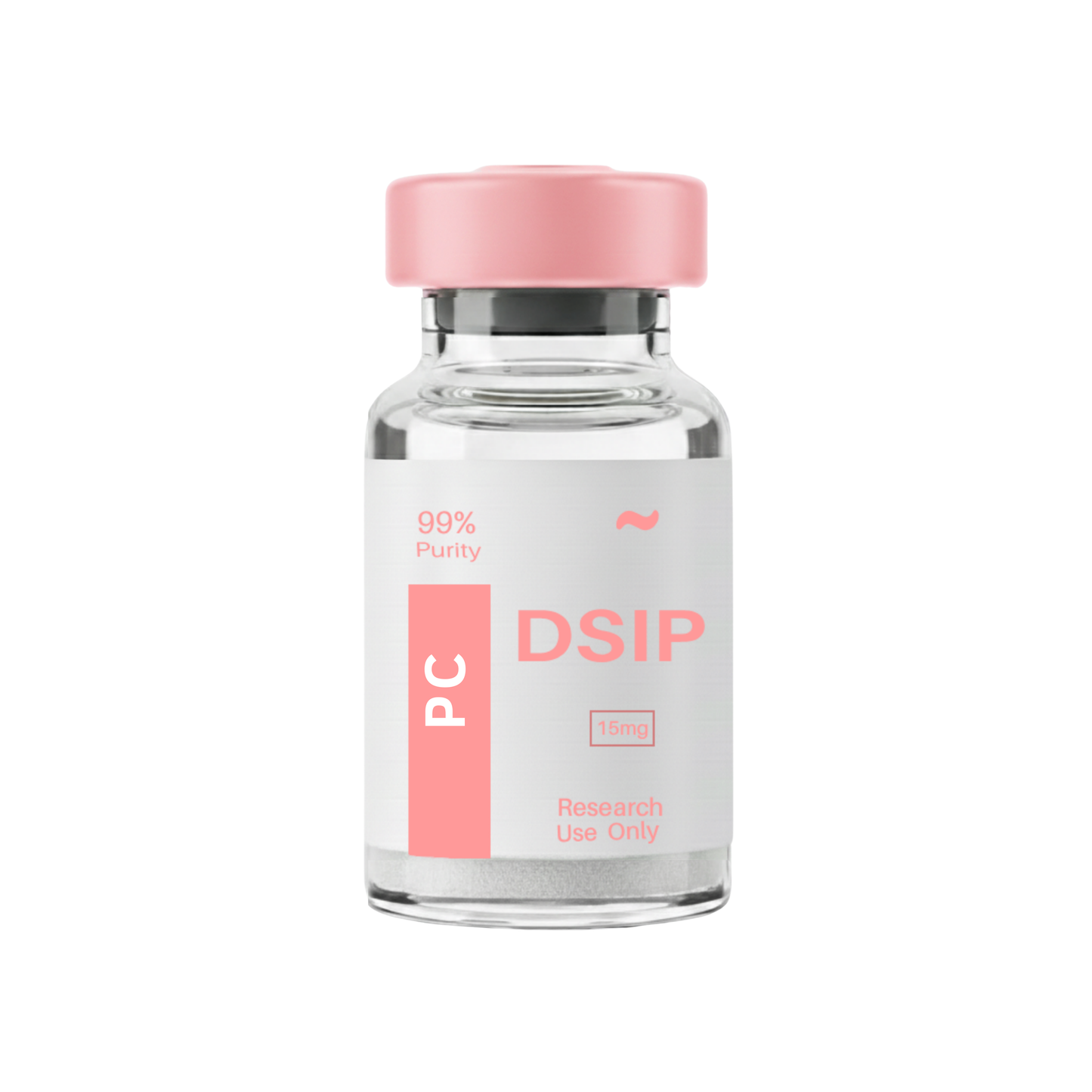
DSIP
DSIP
This batch of DSIP (Delta Sleep-Inducing Peptide) has been third party lab tested and verified for quality.
Contents: Delta Sleep-Inducing Peptide
Form: Powder
Purity: 99.0%
Couldn't load pickup availability
Free Reconstitution Solution automatically added to your cart with each order.
This product is Made, Tested & Shipped From Canada.
Ships Today
Order by 1:00 PM EST
Free Shipping
For 2 or more vials
Verified+

DSIP (Delta Sleep‑Inducing Peptide)
DSIP (Delta Sleep‑Inducing Peptide) is an endogenous nonapeptide first identified in mammalian brain and cerebrospinal fluid, historically linked with the promotion of deep non‑REM (slow‑wave) sleep and enhanced delta‑frequency (0.5–4 Hz) EEG activity. Its primary structure is:
Trp‑Ala‑Gly‑Gly‑Asp‑Ala‑Ser‑Gly‑Glu
DSIP has been employed as a research peptide to investigate sleep architecture, neuroendocrine control, circadian biology, and stress‑adaptation mechanisms. Because its principal receptor(s) and direct signaling targets are not fully defined, DSIP is best regarded as a functional probe for studying peptide‑mediated modulation of CNS activity, pituitary‑hormone release, and integrated brain–body homeostasis.
DSIP provided by Montreal Peptides Canada is supplied as a high‑purity, lyophilized peptide intended exclusively for laboratory and scientific research use. It is not approved for human or veterinary administration, diagnosis, treatment, or consumption.
DSIP Overview
Delta Sleep‑Inducing Peptide was initially characterized based on its capacity to alter sleep patterns and increase delta EEG power. Over time, its application has broadened into several interconnected research areas:
- Sleep and EEG regulation
DSIP is used to examine: - Latency to sleep onset
- Proportion and stability of slow‑wave sleep (SWS)
- Changes in delta‑band EEG power across sleep cycles
- Neuroendocrine integration
Experimental paradigms have assessed DSIP’s influence on: - Growth hormone (GH), ACTH, prolactin, and gonadotropin release
- Coupling between sleep stages and nocturnal hormone surges
- Hypothalamic–pituitary feedback and circadian hormone timing
- Stress and HPA‑axis function
DSIP serves as a tool to explore: - Modulation of ACTH and glucocorticoid responses under stress
- Behavioral and autonomic indices of stress resilience
- Interactions between sleep, stress, and endocrine status
- CNS neuromodulation
DSIP has been evaluated for its ability to interact—directly or indirectly—with: - GABAergic and glutamatergic systems
- Monoaminergic pathways (e.g., serotonin, noradrenaline)
- Overall excitatory–inhibitory balance in key CNS circuits
Because DSIP’s precise receptor pharmacology is still being elucidated, it is often used in exploratory and comparative models rather than as a single‑target reference ligand.
DSIP Structure
Chemical Makeup
- Sequence: Trp‑Ala‑Gly‑Gly‑Asp‑Ala‑Ser‑Gly‑Glu
- Molecular Formula: C₃₅H₄₈N₁₀O₁₅
- Molecular Weight: ~849.82 Da
- Form: Lyophilized peptide powder
- Appearance: White to off‑white solid
- Analytical Characterization (typical):
- Reverse‑phase HPLC (UV detection at ~214 nm)
- LC‑MS (ESI⁺ mode) confirmed against a synthetic DSIP reference standard
DSIP Research
Sleep Architecture and Delta Activity
DSIP’s earliest and most prominent research application concerns slow‑wave sleep and EEG activity:
- Delta‑wave enhancement: Studies have associated DSIP exposure with increased delta‑band power and altered amounts of deep non‑REM sleep in various experimental models.
- Sleep continuity: DSIP is used to explore how peptide signaling affects:
- Sleep onset latency
- Maintenance and fragmentation of SWS
- Post‑deprivation rebound patterns
- Network‑level integration: By combining DSIP with pharmacologic modulators of GABA, serotonin, and other neurotransmitters, researchers can dissect how peptidergic cues interact with established sleep‑regulatory circuits.
These attributes make DSIP a valuable tool for probing the peptide contribution to sleep micro‑ and macro‑architecture.
Neuroendocrine and Pituitary Modulation
DSIP has been examined as a peptide modulator of hypothalamic–pituitary function:
- Pituitary secretion profiles: Selected studies have reported DSIP‑related changes in:
- Growth hormone (GH) release
- ACTH and cortisol/corticosterone dynamics
- Prolactin and gonadotropin secretion in particular experimental paradigms
- Sleep–hormone coupling: DSIP is used to investigate:
- Links between SWS and nocturnal GH surges
- Timing relationships between sleep stages and circadian hormone peaks
- Hypothalamic set‑points: DSIP provides an experimental means of assessing how central peptide signals adjust hypothalamic thresholds and feedback sensitivity within multi‑hormone axes.
Overall, DSIP is a useful probe for understanding how sleep, circadian timing, and pituitary output are integrated.
Stress Response, Autonomic Balance, and CNS Homeostasis
DSIP has also been evaluated in models of stress, autonomic regulation, and CNS stability:
- HPA‑axis modulation: DSIP may:
- Alter ACTH and glucocorticoid responses to stressors
- Influence behavioral indicators of stress and recovery
- Autonomic function: Some studies assess DSIP’s effects on:
- Heart rate and blood‑pressure variability
- Indirect markers of sympathetic/parasympathetic tone
- Neuroprotection and metabolism: DSIP has been investigated for possible effects on:
- Vulnerability to excitotoxic or oxidative insults
- Neuronal energy metabolism and resilience
While results can be model‑specific, this body of work supports DSIP’s role as a peptide tool for studying multi‑system adaptation to internal and external challenges.
Mechanistic and Receptor‑Level Investigations
The precise molecular mechanisms of DSIP action remain an important focus:
- Receptor search: DSIP is used in efforts to:
- Identify candidate peptide receptors or binding sites
- Distinguish between direct receptor‑mediated and indirect network‑mediated effects
- Intracellular signaling: Investigations include:
- Effects on second messengers (e.g., cAMP, Ca²⁺ signaling)
- Modulation of ion‑channel states and neuronal excitability
- Changes in phosphorylation patterns of key signaling proteins
- Structure–activity relationships: Synthetic analogs, truncated fragments, and sequence modifications help identify which residues are:
- Essential for sleep‑modulatory actions
- Involved in endocrine or stress‑related effects
- Dispensable or modulatory
Such work aims to convert DSIP from a phenomenologically defined factor into a fully mechanistically characterized peptide signal.
Article Author
This overview is presented in recognition of the foundational work of Dr. M. Monnier, M.D., Ph.D., and associated investigators who first isolated and characterized Delta Sleep‑Inducing Peptide. Their pioneering demonstrations of a discrete peptide fraction capable of enhancing delta sleep and altering EEG architecture established DSIP as a central experimental tool in peptide‑based sleep and neuroendocrine research.
Scientific Journal Author
The initial identification and structural elucidation of DSIP were carried out by M. Monnier and colleagues, who:
- Isolated a brain‑derived peptide fraction with strong delta sleep‑inducing properties
- Determined the nonapeptide sequence now recognized as DSIP
- Documented its influence on sleep stages and EEG power distribution in controlled studies
Subsequent contributions from researchers such as V.M. Kovalzon, H. Möhler, and others expanded the DSIP literature, examining:
- Neurochemical profiles and possible receptor interactions
- Functional roles in stress, circadian biology, and autonomic regulation
- Use of DSIP as a tool to model peptide‑mediated CNS modulation
This acknowledgment is intended solely to recognize these scientific contributions and does not imply any endorsement, sponsorship, or affiliation between Montreal Peptides Canada and the researchers or institutions cited.
Reference Citations (Representative)
Representative DSIP literature includes:
- Monnier M, et al. Isolation and partial characterization of delta sleep‑inducing peptide. Nature.
- Kovalzon VM. Delta sleep‑inducing peptide: experimental and clinical aspects. Neurosci Biobehav Rev.
- Möhler H, et al. Peptidergic modulation of sleep: pharmacology of DSIP. Neuropharmacology.
- Kryger MH, Roth T, Dement WC, eds. Principles and Practice of Sleep Medicine. Sections on peptide sleep modulators (including DSIP).
- Major biochemical and pharmacologic databases (e.g., NCBI, PubChem) listing DSIP’s structure and core properties.
Researchers should consult primary sources (PubMed, Web of Science) for full references and up‑to‑date DSIP studies.
HPLC/MS
HPLC
Reverse‑phase high‑performance liquid chromatography (RP‑HPLC) with UV detection (typically at 214 nm) is used to verify DSIP purity:
- A chromatogram dominated by a single principal peak corresponding to DSIP
- Only low‑intensity secondary peaks consistent with trace synthetic by‑products or degradation species
Each production lot is benchmarked against a certified synthetic DSIP standard to ensure consistent chromatographic purity.
MS
Mass spectrometry (e.g., LC‑MS, ESI⁺ mode) confirms molecular identity:
- Observation of a molecular ion consistent with DSIP’s theoretical molecular weight (~849.8 Da)
- No significant additional ions indicating major truncations, mis‑sequenced peptides, or extensive degradation within the assay’s sensitivity
Together, HPLC and MS profiling confirm that DSIP meets structural and purity standards suitable for research applications.
STORAGE
Storage Instructions
All DSIP products are manufactured using Lyophilization (Freeze Drying) to ensure robust stability:
- In lyophilized form, DSIP is designed to remain fully stable during shipment for approximately 3–4 months under normal conditions.
After reconstitution with bacteriostatic water:
- Store the DSIP solution refrigerated at ~4°C (39°F).
- Under these conditions, the peptide solution typically remains stable for up to 30 days.
Lyophilization (cryodesiccation) involves:
- Freezing the peptide, then
- Exposing it to low pressure, allowing water to sublimate directly from solid (ice) to gas.
This process produces a stable, white crystalline (“fluffy”) lyophilized peptide that:
- Can be maintained at ambient room temperature for limited periods prior to reconstitution
- Does not require continuous cold‑chain during short‑term shipping or handling when used within the recommended timeframe
Upon receipt of DSIP:
- Keep vials cool and shielded from light.
- For near‑term use (days to a few months), refrigeration at 4°C (39°F) is typically sufficient.
- Lyophilized DSIP is generally stable at room temperature for several weeks, making short‑term ambient storage acceptable when imminent use is planned.
For extended storage (months to years):
- Store lyophilized DSIP at −80°C (−112°F).
- Ultra‑low freezing is strongly recommended for preserving long‑term structural integrity and activity.
Best Practices For Storing Peptides
To preserve DSIP quality and ensure consistent experimental outcomes:
- Short‑term storage:
- Refrigerate at ≤4°C (39°F) when using within weeks to a few months.
- Long‑term storage:
- Store lyophilized DSIP at −80°C (−112°F) for multi‑month to multi‑year preservation.
- Avoid frost‑free freezers:
- These units cycle through warming phases during defrost, which can accelerate peptide degradation.
- Minimize freeze–thaw cycles:
- Repeated thermal cycling can denature or fragment peptides.
- Protect from light and moisture:
- Store in dark, dry conditions to limit photodegradation and hydrolysis.
These practices apply broadly to DSIP and other research‑grade peptides.
Preventing Oxidation and Moisture Contamination
Oxidation and moisture are key contributors to peptide degradation:
- Condensation prevention:
- Allow frozen vials to warm to room temperature before opening to avoid condensation forming on or inside the vial.
- Limit air exposure:
- Open containers only briefly and reseal them promptly and tightly after use.
- Optional inert gas overlay:
- For long‑term storage, consider flushing vial headspace with a dry, inert gas such as nitrogen or argon to reduce oxidative processes.
- Aliquoting strategy:
- Divide DSIP into small, single‑use or limited‑use aliquots so the bulk material is not repeatedly exposed to air or temperature changes.
These measures help maintain peptide stability across multiple experimental sessions.
Storing Peptides In Solution
Peptides in solution are more fragile than in lyophilized form:
- Use sterile buffers with a pH typically in the 5–6 range, unless protocol requirements differ.
- Prepare small aliquots of reconstituted solution to avoid repeated freeze–thaw cycles.
- At 4°C (39°F), most peptide solutions remain stable for up to ~30 days.
- For more labile sequences or longer storage, keep solutions frozen and thaw immediately before use.
Whenever feasible, maintain DSIP in lyophilized form and reconstitute fresh solutions just before use.
Peptide Storage Containers
Container selection contributes to peptide stability:
- Use clean, chemically inert vials appropriately sized to minimize headspace.
- Glass vials provide optimal chemical resistance and transparency.
- Plastic vials (polystyrene or polypropylene) are also acceptable:
- Polystyrene: clear and easy to inspect; lower chemical resistance.
- Polypropylene: more chemically resistant and durable; typically translucent.
Peptides are frequently shipped in plastic containers to reduce breakage risk and may be transferred to glass vials for long‑term storage, provided handling is clean and contamination‑free.
Peptide Storage Guidelines: General Tips
To preserve DSIP and other peptides over time:
- Store in a cold, dry, and dark environment.
- Avoid repeated freeze–thaw cycles.
- Minimize exposure to air and moisture to reduce oxidation and hydrolysis.
- Protect from direct and prolonged light.
- Prefer lyophilized storage for long‑term keeping; avoid unnecessarily long storage in solution.
- Aliquot peptides based on experimental needs to reduce handling and environmental stress.
-

HIGHEST QUALITY PEPTIDES
Our products are scientifically formulated and manufactured in cGMP-compliant facilities.
-

FAST DELIVERY
Enjoy fast and reliable 3–5 day shipping.
-

Dedicated Customer Service
Our customer service team is highly knowledgeable in peptide research and its applications. We’re available 24/7 to assist you.
You may also like
-
SAVE 23%HCG - Research Grade Peptide Hormone
Regular price From $72.00Regular price From $72.00 Sale priceUnit price / per$94.0023% -
SAVE 25%Tirzepatide
Regular price From $50.00Regular price From $50.00 Sale priceUnit price / per$67.0025% -
SAVE 24%Thymosin Alpha-1
Regular price From $79.00Regular price From $79.00 Sale priceUnit price / per$104.0024% -
SAVE 23%Tesamorelin
Regular price From $80.00Regular price From $80.00 Sale priceUnit price / per$105.0023% -
SAVE 23%Survodutide
Regular price $299.00Regular price $299.00 Sale priceUnit price / per$392.0023% -
SAVE 26%Sterile Water
Regular price From $14.00Regular price From $14.00 Sale priceUnit price / per$19.0026% -
SAVE 23%SLU-PP-332
Regular price $125.00Regular price $125.00 Sale priceUnit price / per$164.0023% -
SAVE 23%Sermorelin
Regular price From $70.00Regular price From $70.00 Sale priceUnit price / per$92.0023% -
SAVE 23%Semaglutide
Regular price From $36.00Regular price From $36.00 Sale priceUnit price / per$47.0023% -
SAVE 23%Retatrutide Triple Agonist
Regular price From $90.00Regular price From $90.00 Sale priceUnit price / per$118.0023% -
SAVE 26%Oxytocin Acetate
Regular price $42.00Regular price $42.00 Sale priceUnit price / per$57.0026% -
SAVE 25%Melanotan II (MT2)
Regular price $50.00Regular price $50.00 Sale priceUnit price / per$67.0025% -
SAVE 24%Lipo-C with B Vitamins
Regular price $85.00Regular price $85.00 Sale priceUnit price / per$112.0024% -
SAVE 23%L-Carnitine
Regular price $97.00Regular price $97.00 Sale priceUnit price / per$127.0023% -
SAVE 23%Lemon Bottle 10mg
Regular price $80.00Regular price $80.00 Sale priceUnit price / per$105.0023% -
SAVE 24%KPV Tripeptide
Regular price From $56.00Regular price From $56.00 Sale priceUnit price / per$74.0024% -
KLOW Blend - GHK-CU + TB-500 + BPC-157 + KPV 10mg
Regular price $200.00Regular price $200.00 Sale priceUnit price / per$261.0023% -
Kisspeptin-10 - Premium Research Peptide
Regular price From $65.00Regular price From $65.00 Sale priceUnit price / per$85.0023% -
SAVE 23%Ipamorelin
Regular price From $32.00Regular price From $32.00 Sale priceUnit price / per$42.0023% -
SAVE 24%IGF-1 LR3 (Long R3)
Regular price From $40.00Regular price From $40.00 Sale priceUnit price / per$53.0024% -
SAVE 24%HMG 75iu - Premium Research Peptide
Regular price $80.00Regular price $80.00 Sale priceUnit price / per$106.0024% -
SAVE 24%Hyaluronic
Regular price $28.00Regular price $28.00 Sale priceUnit price / per$37.0024% -
SAVE 23%HGH Fragment 176-191
Regular price $97.00Regular price $97.00 Sale priceUnit price / per$127.0023% -
SAVE 23%HGH 191AA (Somatropin)
Regular price From $55.00Regular price From $55.00 Sale priceUnit price / per$72.0023% -
SAVE 23%HCG - Premium Research Peptide
Regular price From $72.00Regular price From $72.00 Sale priceUnit price / per$94.0023% -
Gonadorelin - Premium Research Peptide
Regular price $50.00Regular price $50.00 Sale priceUnit price / per$67.0025% -
SAVE 23%Glutathione
Regular price From $75.00Regular price From $75.00 Sale priceUnit price / per$98.0023% -
SAVE 23%Glow BPC-157 + GHK-CU + TB-500
Regular price $139.00Regular price $139.00 Sale priceUnit price / per$181.0023%
Every vial we sell comes from a lab that follows current Good Manufacturing Practices (cGMP). That means each step of production is documented and controlled. Before a batch is released, it’s tested by independent third-party labs for purity, identity, and sterility. Certificates of analysis are available so you can see the exact test results.
Yes. The labs we work with use ISO-certified clean rooms where air quality, equipment, and handling procedures are tightly regulated. Staff are trained to pharmaceutical-grade standards. This ensures the peptides are produced in an environment that minimizes contamination risks.
Peptides in lyophilized (freeze-dried) form are stable at room temperature for transport. Once you receive them, refrigeration is recommended to maintain long-term integrity. We package every order securely to prevent damage and ship promptly, so your vials arrive in optimal condition.
We operate under strict in-house protocols that follow current Good Manufacturing Practices (cGMP). That means our team oversees the entire process from sourcing raw amino acids to the final lyophilized vial. Nothing is outsourced or repackaged. This gives us full control over purity, consistency, and sterility, and it’s why we can stand behind every single vial we ship.
Store them in the refrigerator, away from direct light and heat. If you need to keep them longer, some peptides can be stored frozen. Each vial comes with clear handling instructions so you know the proper conditions for stability.
The strongest proof is transparency. For every peptide, we can provide certificates of analysis, manufacturing documentation, and references to the published scientific research behind it. If you ever have questions, we’ll show you the data rather than ask you to take our word for it.
The difference is transparency. Most sites give you a product name and a price. We provide full batch testing, lab documentation, and direct access to certificates of analysis so you don’t have to guess what you’re getting. When you order from us, you know exactly what’s in the vial, where it was made, and how it was verified.