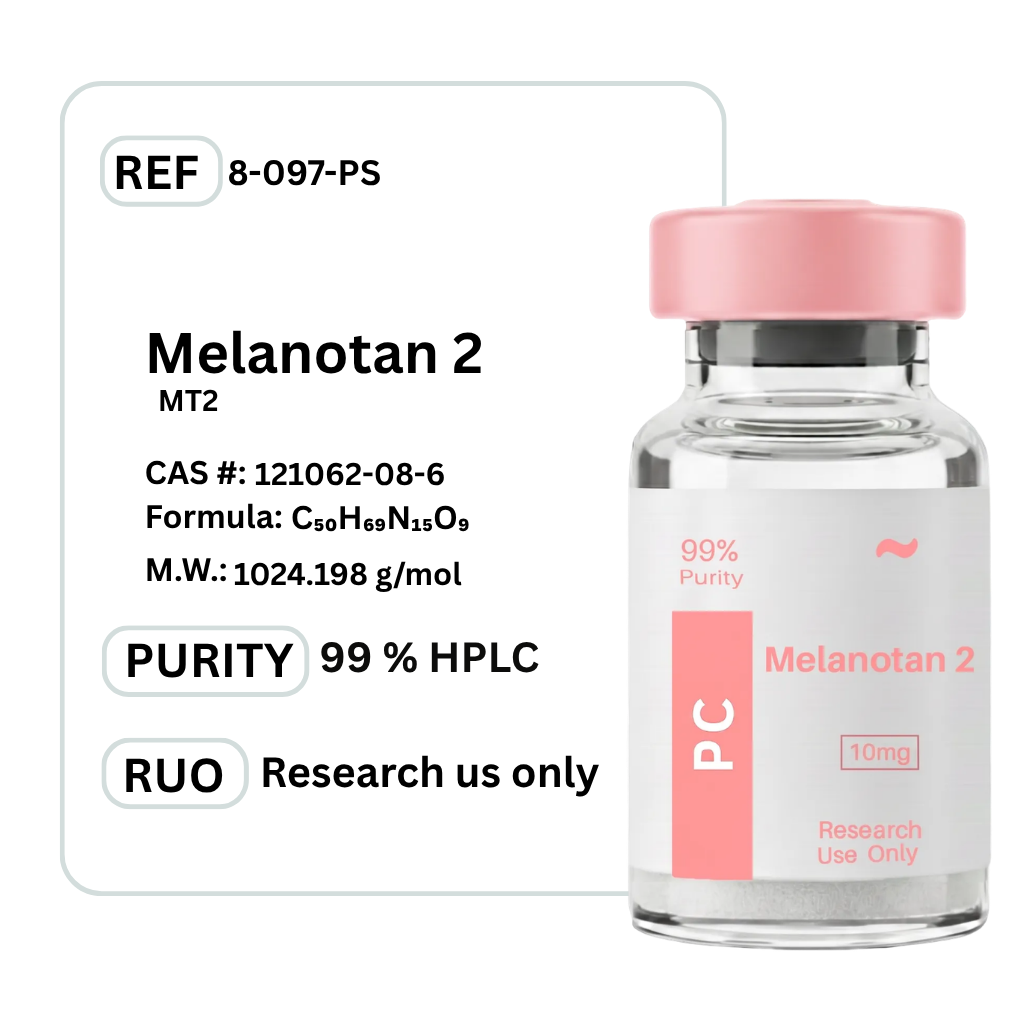
Melanotan 2 Peptide
Melanotan II (MT-II) is a synthetic, cyclic heptapeptide, developed as a highly potent analog of the natural alpha-melanocyte-stimulating hormone (alpha-MSH). It functions as an agonist for the melanocortin receptor (MCR) system, with a high degree of selectivity for MC4R and MC1R. While its initial research focused on stimulating melanogenesis (melanin production) for skin pigmentation, its current research focus is on its diverse biological effects, including its influence on appetite control, sexual function, and various centrally-mediated neurological functions.
Melanotan 2 Peptide Overview
Melanotan II (MT-II) is a potent synthetic alpha-MSH analogue first synthesized at the University of Arizona in the 1980s. The peptide's creation was motivated by the observation that the natural alpha-MSH hormone influenced both pigmentation and specific behavioral and physiological responses in animal models.
Originally designed as a research tool to promote skin pigmentation without requiring UV exposure, MT-II's range of biological activities quickly broadened its research scope. Current scientific investigations explore its effects on metabolic regulation, sexual behavior, and appetite suppression. Preliminary findings suggest roles in areas such as modulating compulsive behaviors, suppressing appetite, and regulating glucagon, though these effects are still under investigation and are not established for clinical use.
Melanotan 2 Peptide Structure
MT-II is a synthetic molecule structurally classified as a cyclic heptapeptide. Its seven amino acids are arranged in a ring, which provides enhanced stability and a specific pharmacological profile, enabling its potent and selective agonism at the melanocortin receptor subtypes, particularly MC1R and MC4R.
Melanotan 2 Peptide Research
Melanotan II and Melanocortin Signaling
Melanotan II (MT-II) exerts its biological functions by acting as an agonist on the Melanocortin Receptor (MCR) family, which includes five subtypes (MC1R–MC5R). MT-II demonstrates its highest binding affinity for MC4R and MC1R, and moderate binding at MC3R. This broad yet selective activation across different receptor subtypes, which are distributed across various physiological systems, underpins the peptide’s diverse effects.
MCR Subtype
Primary Tissue Location
MT-II Research Focus
MC1R
Melanocytes
Stimulates melanin synthesis for pigmentation studies.
MC2R
Adrenal Cortex
Involved in stress hormone release and adrenal function.
MC3R
Central Nervous System
Explored in relation to metabolic and energy balance.
MC4R
Central Nervous System
Key regulator of sexual function, appetite, and arousal.
MC5R
Exocrine Glands
Studied for its role in secretion and metabolic processes.
Melanotan II and Autism
Emerging research has highlighted the potential of Melanotan II (MT-II) in models of Autism Spectrum Disorder (ASD). Data from the maternal immune activation (MIA) mouse model of ASD suggests that MT-II administration may alleviate certain autistic-like behaviors, building upon the known therapeutic potential of oxytocin in addressing social deficits in ASD.
In the MIA mouse model, MT-II, which is known to enhance oxytocin secretion, was found to successfully reverse several core ASD symptoms, including deficits in social interaction, communication, and repetitive behavior patterns.
The study also found that MT-II significantly upregulated oxytocin receptor expression in brain regions critical for social cognition. These results suggest MT-II could be a modulator of neuroendocrine pathways influencing social behavior and developmental neurodisorders.
Melanotan 2 and Hunger
Compelling evidence from animal models demonstrates that MT-II can suppress hunger and reduce fat accumulation. As a potent activator of the melanocortin-4 receptor (MC4R), MT-II is crucial in regulating food intake. In mice, MT-II not only lowers total food consumption but also induces a strong aversion to high-fat foods, an effect entirely dependent on the MC4R.
The activity of MT-II is functionally compared to the satiety hormone leptin. However, MT-II is hypothesized to be superior for weight management because it appears to activate both leptin-dependent and leptin-independent satiety pathways. Furthermore, MT-II influences the expression of thyrotropin-releasing hormone (TRH), linking it to central satiety pathways.
Melanotan 2 and Diabetes
MT-II is researched for its role in diabetes based on the anti-diabetic effects of leptin, which regulates blood sugar (enhancing glucose uptake and reducing glucagon) independent of insulin. Since these effects are melanocortin receptor-mediated, MT-II demonstrates comparable regulatory effects.
A key pharmacological distinction is MT-II's superior ability to cross the blood-brain barrier compared to external leptin. This greater accessibility allows MT-II to more effectively target the central nervous system pathways involved in metabolic regulation.
Melanotan 2, Impulse Control, and Alcohol Intake
The MC4R receptor is critically involved in regulating impulse control. Experimental studies in rats show that MT-II administration decreases alcohol consumption while increasing water intake. Furthermore, new research indicates a strong synergistic effect with naltrexone, significantly boosting naltrexone’s efficacy in reducing binge-like ethanol intake in mice.
These results suggest MT-II could be an important tool for investigating the neurobiological basis of craving and desire, potentially leading to new therapies for alcohol-related disorders and other impulsive behaviors.
Melanotan 2 and Erectile Dysfunction
While traditional ED treatments target vascular issues, MT-II has been shown to be effective through its action on the central nervous system pathways. This central mechanism provides a benefit for non-vascular causes of ED. Clinical studies indicated that approximately 80% of men unresponsive to Viagra experienced improvement with MT-II treatment. Research is ongoing regarding its potential for both male and female sexual desire disorders.
Article Author
This literature review was compiled, written, and organized by Dr. Mac E. Hadley, Ph.D., a distinguished authority in melanocortin peptide pharmacology. Dr. Hadley is famous for the discovery that melanocortin peptides influence sexual function in both men and women, which significantly spurred clinical interest in Melanotan II. His foundational work at the University of Arizona was key to advancing the scientific understanding of melanocortin receptor biology and the therapeutic potential of peptide analogs.
Scientific Journal Author
Dr. Mac E. Hadley collaborated closely with other leading researchers, including Dr. Victor J. Hruby, Dr. H. Wessells, and Dr. Stephen H. King. Their combined studies were instrumental in deepening the pharmacological knowledge of Melanotan II. Their publications in major scientific journals clarified the peptide's receptor selectivity, molecular function, and clinical relevance as a melanocortin receptor agonist, establishing the scientific foundation for MT-II's diverse effects.
Reference Citations
- Ryakhovsky, Vladimir V et al. "The first preparative solution phase synthesis of Melanotan II." Beilstein Journal of Organic Chemistry vol. 4 (2008): 39. doi:10.3762/bjoc.4.39. https://pubmed.ncbi.nlm.nih.gov/19043625/
- Hadley, Mac E. "Discovery that a melanocortin regulates sexual functions in male and female humans." Peptides, Volume 26, Issue 10, 2005, Pages 1687-1689. https://doi.org/10.1016/j.peptides.2005.01.023
- King, Stephen H et al. "Melanocortin receptors, melanotropic peptides and penile erection." Current topics in medicinal chemistry vol. 7,11 (2007): 1098-1106. https://www.ncbi.nlm.nih.gov/pmc/articles/PMC2694735/
- Peters, Björn, et al. "Melanotan II: a possible cause of renal infarction: review of the literature and case report." CEN case reports vol. 9,2 (2020): 159-161. https://www.ncbi.nlm.nih.gov/pmc/articles/PMC7148395/
- Ter Laak, Mariël P, et al. "The potent melanocortin receptor agonist melanotan-Il promotes peripheral nerve regeneration and has neuroprotective properties in the rat." European Journal of Pharmacology vol. 462,1-3 (2003): 179-83. https://pubmed.ncbi.nlm.nih.gov/12591111/
- Wessells, H et al. "Melanocortin receptor agonists, penile erection, and sexual motivation: human studies with Melanotan II." International journal of impotence research vol. 12 Suppl 4 (2000): S74-9. https://pubmed.ncbi.nlm.nih.gov/11035391/
- Minakova E, Lang J, Medel-Matus JS, Gould GG, Reynolds A, Shin D, Mazarati A, Sankar R. "Melanotan-Il reverses autistic features in a maternal immune activation mouse model of autism." PLoS One. 2019 Jan 10;14(1):e0210389. doi: 10.1371/journal.pone.0210389. https://pubmed.ncbi.nlm.nih.gov/30629642/
- Dorr RT, Lines R, Levine N, Brooks C, Xiang L, Hruby VJ, Hadley ME. "Evaluation of melanotan-II, a superpotent cyclic melanotropic peptide in a pilot phase-I clinical study." Life Sci. 1996;58(20):1777-84. https://pubmed.ncbi.nlm.nih.gov/8637402/
Important Research Disclaimer
ALL ARTICLES AND PRODUCT INFORMATION PROVIDED ON THIS WEBSITE ARE FOR INFORMATIONAL AND EDUCATIONAL PURPOSES ONLY.
The products offered on this website are furnished for in-vitro studies only. In-vitro studies (Latin: "in glass") are experiments conducted outside of a living organism. These products are not classified as medicines or drugs and have not been approved by the FDA or any regulatory body to prevent, treat or cure any medical condition, ailment, or disease. Introduction of any kind into humans or animals is strictly forbidden by law.
Storage
Storage Instructions
All products are prepared via a lyophilization (freeze-drying) process, which ensures stability during shipping for approximately 3–4 months.
- Lyophilized Peptides (Powder): The stable, white crystalline powder is safe for storage at room temperature for several weeks. For short-term use (days, weeks, or months), refrigeration below 4 degrees C (39 degrees F) is sufficient. For extended storage (months to years), freezing at -80 degrees C (-112 degrees F) is highly recommended to maintain structural integrity.
- Reconstituted Peptides (Solution): Once mixed with bacteriostatic water, the peptide solution must be stored in a refrigerator (below 4 degrees C). Reconstituted peptides are typically stable for up to 30 days.
Best Practices For Storing Peptides
Proper storage protocols are essential for maintaining the accuracy and reliability of laboratory results by minimizing contamination, oxidation, and degradation.
Storage Condition
Peptide Form
Recommended Temperature
Key Practice
Short-Term
Lyophilized or Reconstituted
Below 4 degrees C (Refrigerated)
Keep cool and protected from light.
Long-Term
Lyophilized
-80 degrees C (Frozen)
Minimize freeze-thaw cycles; avoid frost-free freezers.
Preventing Oxidation and Moisture Contamination
Protecting peptides from exposure to air and moisture is critical for stability.
- Moisture Control: Always allow the vial to reach room temperature before opening after removal from the freezer to prevent condensation from contaminating the powder.
- Air Exposure: Minimize the time the container is open. Promptly reseal the container. Storing the remaining peptide under a dry, inert gas (e.g., nitrogen or argon) can help prevent oxidation. Peptides containing cysteine (C), methionine (M), or tryptophan (W) residues are especially sensitive to oxidation.
- Handling: To maintain long-term stability, avoid frequent thawing and refreezing. Divide the total peptide into smaller aliquots for single-use experiments.
Storing Peptides In Solution
Peptide solutions have a significantly shorter shelf life and are more prone to degradation than lyophilized forms.
- Degradation Risk: Peptides with residues like Cysteine, Methionine, Tryptophan, Aspartic acid, Glutamine, or N-terminal Glutamic acid degrade more rapidly in solution.
- Guidelines: If liquid storage is unavoidable, use sterile buffers with a pH between 5 and 6. Aliquots should be prepared to minimize freeze-thaw cycles. Most peptide solutions remain stable for up to 30 days when refrigerated at 4 degrees C.
Peptide Storage Containers
Containers must be clean, durable, and chemically resistant, and appropriately sized to minimize air space. Glass vials offer the best combination of clarity, stability, and chemical inertness. Plastic vials are also suitable.
Peptide Storage Guidelines: General Tips
Adhere to these best practices for optimal peptide stability:
- Store peptides in a cold, dry, and dark environment.
- Avoid repeated freeze-thaw cycles.
- Minimize exposure to air and light.
- Keep peptides lyophilized for long-term storage whenever possible.
- Aliquot the peptide based on experimental needs.