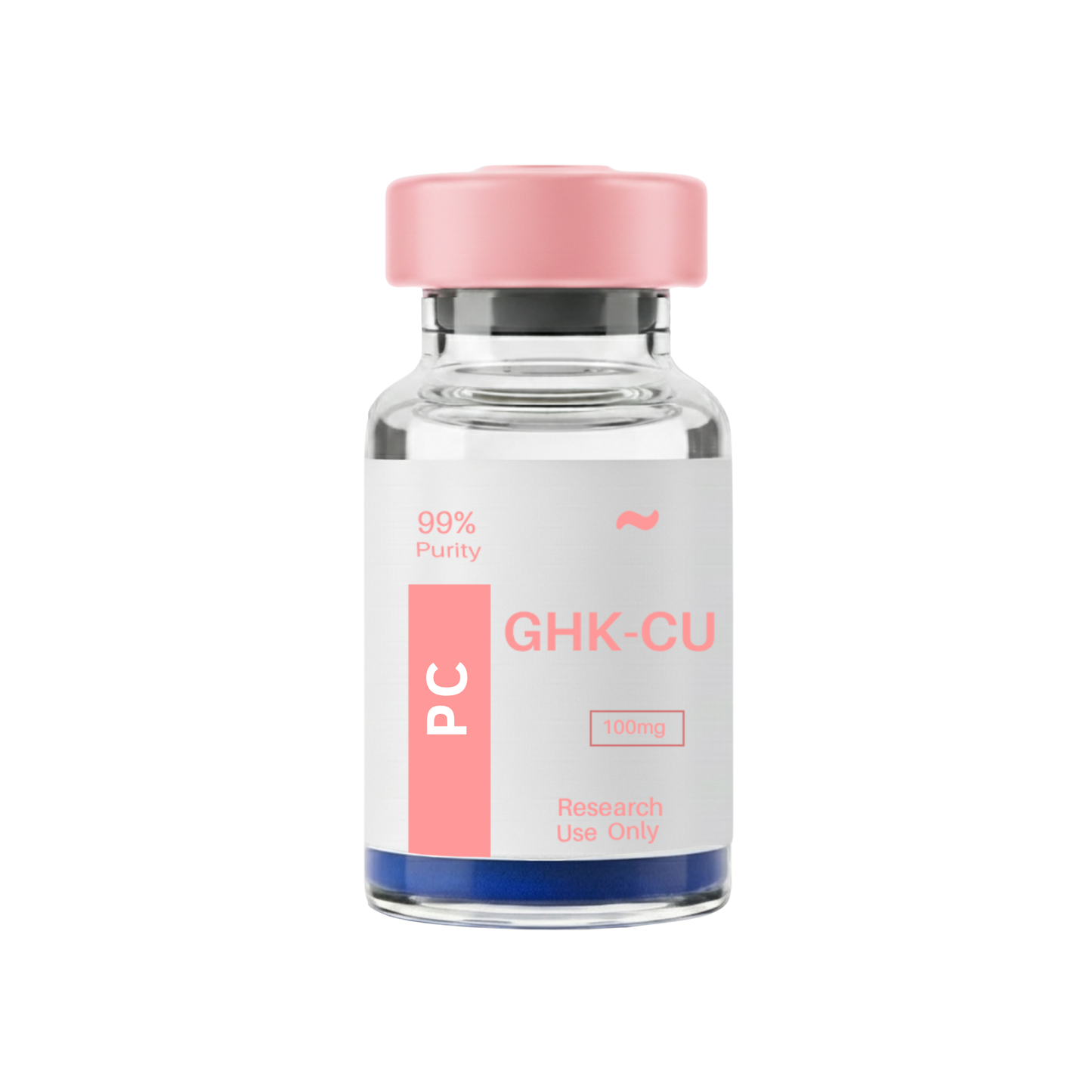
GHK-Cu
GHK-Cu is a naturally occurring copper-binding tripeptide first identified in human blood plasma and later found in urine and saliva. Extensive research indicates that this short peptide supports wound healing and immune function, exhibits anti-aging and antioxidant activity, enhances protein synthesis, has antimicrobial properties, and promotes healthier skin and fibroblast function.
GHK-Cu Research
1. GHK-Cu and Skin Healing
As a natural constituent of human blood, GHK-Cu plays an important role in skin repair and regeneration. In cultured skin models, GHK has been shown to:
- Stimulate both synthesis and breakdown (remodeling) of collagen
- Regulate glycosaminoglycan production
- Influence extracellular matrix components such as proteoglycans and chondroitin sulfate
These actions are partly mediated by GHK-Cu’s ability to recruit:
- Fibroblasts
- Immune cells
- Endothelial cells
The peptide attracts these cells to the injury site and appears to coordinate their participation in tissue repair.
Studies report that GHK-Cu can improve overall skin quality by:
- Increasing skin elasticity
- Tightening and firming the skin
- Reducing sun-induced damage
- Diminishing hyperpigmentation
- Softening the appearance of fine lines and wrinkles
By modulating collagen metabolism, GHK-Cu may:
- Reduce scar visibility
- Limit hypertrophic scarring
- Smooth rough or uneven skin
- Help restore the structural integrity of aged skin
These effects are linked in part to increased transforming growth factor-β (TGF-β) levels. GHK-Cu likely acts through multiple biochemical pathways, including regulation at the level of gene transcription.
In murine burn models, GHK-Cu treatment has been shown to accelerate healing by up to 33%. Beyond recruiting fibroblasts and immune cells, it also promotes angiogenesis (new blood vessel formation), which is especially relevant in burns where vascular regrowth is hampered by thermal damage.
2. GHK-Cu and Bacteria
Infection by bacterial and fungal pathogens is a major cause of delayed or non-healing wounds, especially in burn patients and individuals with impaired immunity (e.g., diabetes, HIV).
When combined with specific fatty acids, GHK-Cu forms a potent antimicrobial complex effective against a range of bacteria and fungi commonly found in chronic and complicated wounds.
Clinical research in diabetic patients with ulcers has shown that GHK-Cu can outperform standard treatment regimens. Reported outcomes include:
- Approximately 40% greater wound closure
- Around 27% lower infection rates
Patients with ischemic open wounds receiving GHK-Cu exhibited healthier granulation tissue and generally better wound quality.
3. GHK-Cu, Cognition, and Nervous System Function
The mechanisms underlying neuronal loss in disorders such as Alzheimer’s disease are not fully understood, limiting treatment options. Experimental work suggests that GHK-Cu may help offset age-related declines in neuronal function and may help preserve neural tissue.
Documented effects of GHK-Cu include:
- Enhanced angiogenesis in nervous system tissues
- Increased expression of nerve growth factor (NGF)
- Reduction of anxiety-like behavior in rodent models
- Partial “reprogramming” of pathological gene expression toward more normal patterns
GHK-Cu is present in relatively high concentrations in the brain but declines with age. Evidence indicates that physiological levels of GHK-Cu help protect tissues from gene dysregulation and other stressors, and that decreasing levels may contribute to the onset of neurodegenerative processes.
In rat models of intracerebral hemorrhage and stroke, GHK-Cu appears to protect brain function by inhibiting apoptosis (programmed cell death). This effect involves the miR-339-5p/VEGFA pathway, which is activated after brain injury. GHK-Cu administration markedly reduced—and in some cases prevented—neuron loss associated with miR-339-5p overexpression.
4. GHK-Cu and Side Effects of Chemotherapy
Certain chemotherapeutic agents, notably bleomycin, can cause severe pulmonary fibrosis. In mouse models, GHK-Cu has been shown to:
- Inhibit bleomycin-induced lung fibrosis
- Decrease inflammatory activity in lung tissue
Mechanistic studies suggest that GHK-Cu modifies levels of key inflammatory cytokines:
These molecules drive inflammatory and fibrotic changes in the lung extracellular matrix and epithelium. By reducing their expression or activity, GHK-Cu limits fibrotic remodeling and helps preserve respiratory function.
Similar protective actions have been observed in mouse models of acute respiratory distress syndrome (ARDS), where GHK-Cu reduced lung injury and appeared to act mainly through anti-inflammatory pathways.
5. GHK-Cu and Pain Reduction
Rodent studies indicate that GHK-Cu has a dose-dependent effect on pain-related behaviors, consistent with peripheral analgesic properties. There is also evidence that GHK-related peptides interact with L-arginine, an amino acid with known analgesic and antiepileptogenic effects, potentially enhancing its pain-modulating activity.
These findings suggest that GHK-Cu could inform the development of novel pain therapies that circumvent the limitations of opioids and long-term NSAID use.
Preclinical work describes GHK-Cu as having minimal side effects, low oral bioavailability, and excellent subcutaneous bioavailability in mice. Animal dosing cannot be directly extrapolated to humans. GHK-Cu from Peptide Sciences is intended exclusively for educational and scientific research use and is not for human consumption. It should be purchased and handled only by qualified research or medical professionals.
Article Author
This literature overview was researched, edited, and organized by Dr. Logan, M.D. Dr. Logan holds a Doctor of Medicine degree from Case Western Reserve University School of Medicine and a B.S. in molecular biology.
Scientific Journal Author
Loren Pickart, Ph.D. is widely regarded as a leading scientist in GHK/ GHK-Cu research, with 109 peer-reviewed publications. His contributions include:
- Development of patents related to GHK
- Comprehensive analyses of GHK’s impact on expression of more than 4,150 human genes
His published work explores potential applications of GHK in:
- Skin inflammation
- Metastatic cancer
- Chronic obstructive pulmonary disease (COPD)
and indicates additional beneficial effects on:
- Nervous system function
- Gastrointestinal health
- Mitochondrial function
Dr. Pickart’s autobiographical writings provide context on his motivations, background, and lifelong training in peptide science.
He is cited here strictly to acknowledge his scientific contributions. This citation does not imply endorsement or support of this product, nor any financial, professional, or other relationship between Peptide Sciences and Dr. Pickart. The purpose is solely to credit the researchers whose work underpins much of the current understanding of GHK-Cu.
Referenced Citations
- Pickart L, Vasquez-Soltero JM, Margulies A. GHK Peptide as a Natural Modulator of Multiple Cellular Pathways in Skin Regeneration. BioMed Res Int. 2015;2015:648108.
- Gruchlik A, Chodurek E, Dzierzewicz Z. Effect of GLY-HIS-LYS and its copper complex on TGF-β secretion in normal human dermal fibroblasts. Acta Pol Pharm. 2014;71(6):954–958.
- Pickart L, Margulies A. Regenerative and Protective Actions of the GHK-Cu Peptide in the Light of the New Gene Data. Int J Mol Sci. 2018;19(7).
- Wang X, et al. GHK-Cu liposomes accelerate scald wound healing in mice by promoting cell proliferation and angiogenesis. Wound Repair Regen. 2017;25(2):270–278.
- Kulawska M, Kulawska-Kaczur J, Dzerdzinska K. In vitro studies of antimicrobial activity of Gly-His-Lys conjugates as potential and promising candidates for therapeutics in skin and tissue infections. Bioorg Med Chem Lett. 2015;25(3):542–546.
- Mulder GD, et al. Enhanced healing of ulcers in patients with diabetes by topical treatment with glycyl-L-histidyl-L-lysine copper. Wound Repair Regen. 1994;2(4):259–269.
- Canapp SO, et al. The effect of topical tripeptide-copper complex on healing of ischemic open wounds. Vet Surg. 2003;32(6):515–523.
- Pickart L, Vasquez-Soltero JM, Margulies A. The Effect of the Human Peptide GHK on Gene Expression Relevant to Nervous System Function and Cognitive Decline. Brain Sci. 2017;7(2).
- Zhang H, Wang Y, He Z. Glycine-Histidine-Lysine (GHK) Alleviates Neuronal Apoptosis Due to Intracerebral Hemorrhage via the miR-339-5p/VEGFA Pathway. Neuropsychiatr Dis Treat. 2018;14:643–655.
- Zhou XM, et al. GHK Peptide Inhibits Bleomycin-Induced Pulmonary Fibrosis in Mice by Suppressing TGFβ1/Smad-Mediated Epithelial-to-Mesenchymal Transition. Front Pharmacol. 2017;8:904.
- Park J-R, Lee H, Kim S-I, Yang S-R. The tri-peptide GHK-Cu complex ameliorates lipopolysaccharide-induced acute lung injury in mice. Oncotarget. 2016;7(35):58405–58417.
- Senel-Yanova LA, Deligheyan ME. Effects of Tripeptide Gly-His-Lys in Pain-Induced Aggressive-Defensive Behavior in Rats. Bull Exp Biol Med. 2017;164(2):140–143.
- Senel-Yanova LA, Proshlyakov DV. Binding of Oligopeptides to L-Arginine Inverts Its Analgesic and Antiepileptogenic Effects. Bull Exp Biol Med. 2018;165(5):621–624.