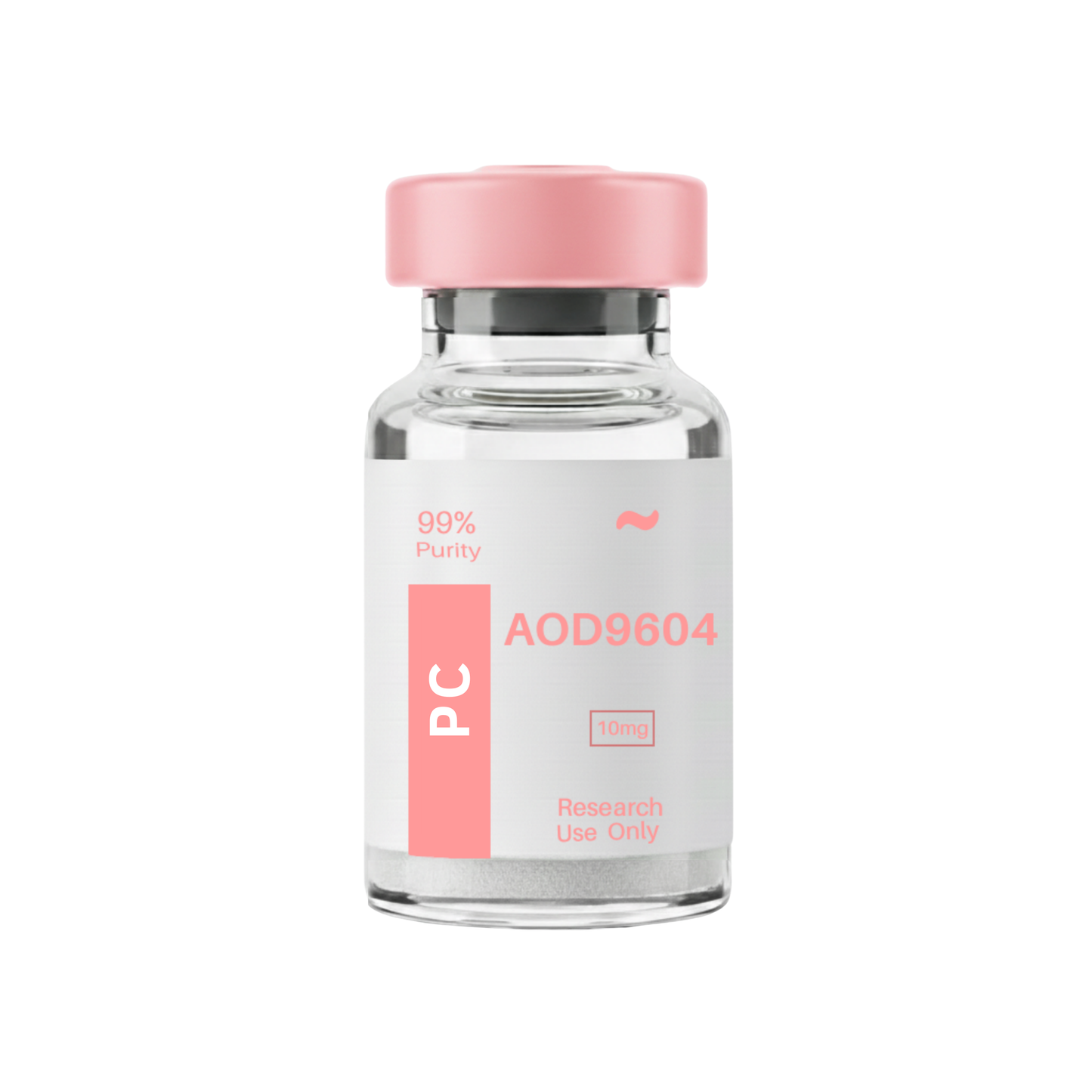
AOD9604
AOD9604
This batch of AOD-9604 Fragment Peptide has been third party lab tested and verified for quality.
Contents: AOD9604
Form: Powder
Purity: 99.6%
Couldn't load pickup availability
Free Reconstitution Solution automatically added to your cart with each order.
This product is Made, Tested & Shipped From Canada.
Ships Today
Order by 1:00 PM EST
Free Shipping
For 2 or more vials
Verified+

AOD 9604 – Growth Hormone Fragment Research Peptide
1. Product Overview
AOD 9604 is a synthetic peptide fragment derived from the C‑terminal region (176–191) of human growth hormone (hGH), with specific sequence modifications to focus on metabolic activity rather than broad growth-related effects. It is used in research to study growth hormone fragment biology, particularly in the context of fat metabolism and energy regulation.
Typical research applications for AOD 9604 include:
- Investigation of adipocyte function and lipid turnover
- Studies of energy balance and body-composition–related pathways
- Structure–activity analyses of growth hormone fragments
- Comparative signaling studies versus full-length hGH
For research use only. Not for human or veterinary use.
2. Mechanistic Profile
AOD 9604 is a C‑terminal growth hormone fragment developed to explore fragment-specific metabolic actions distinct from classical GH receptor–IGF‑1 signaling.
Fragment-Associated Metabolic Cascade (Conceptual)
Although precise receptor targets remain under active investigation, experimental evidence suggests that AOD 9604 may:
- Engage signaling mechanisms influenced by the C‑terminal tail of hGH.
- Modulate intracellular pathways governing lipid mobilization and storage in adipocytes.
- Influence kinase- and potentially cAMP-linked signaling routes, in a manner that differs from intact hGH.
- Promote a shift toward increased lipid turnover and/or altered fat deposition in certain models.
- Do so with relatively reduced activation of canonical GH–IGF‑1 pathways compared to full-length growth hormone.
This mechanistic profile underpins its use in:
- Studies of GH fragment selectivity and domain-specific actions
- Research on adipose tissue biology and metabolic signaling
- Explorations of how GH-derived peptides affect energy homeostasis
All mechanistic statements refer to research settings and are not clinical claims.
3. Structural & Chemical Data
- Peptide Type: Synthetic fragment corresponding to the hGH 176–191 region, with defined modifications
- Class: Short linear peptide (growth hormone fragment analog)
- Biological Origin: Conceptually derived from human pituitary growth hormone
Typical characteristics:
- Approximate Length: Short peptide (on the order of 15–20 amino acids)
- Approximate Molecular Mass: ~1.5–2.0 kDa (exact mass is sequence-specific)
AOD 9604 is designed to:
- Retain C‑terminal features of hGH implicated in lipid and energy metabolism
- Minimize broader anabolic or mitogenic activities associated with intact hGH
For precise sequence and molecular weight, refer to the lot-specific Certificate of Analysis (CoA).
4. Analytical Characterization (HPLC / MS)
HPLC
- AOD 9604 is typically purified to ≥ 98 % by High-Performance Liquid Chromatography (HPLC).
- Retention time and peak shape are checked against validated internal peptide standards to ensure batch consistency.
MS
- Identity is confirmed by mass spectrometry (MS / LC‑MS):
- Measured molecular ion matches the expected mass for the specified AOD 9604 sequence.
- Fragmentation spectra can be used to confirm sequence and structural integrity as needed.
This analytical framework supports use in:
- Mechanistic cell-based and biochemical assays
- Peptide quantification and assay validation
- Comparative evaluations across GH fragment analogs
5. Key Research Uses
5.1 Adipocyte Metabolism & Lipid Handling
AOD 9604 is frequently used in:
- In vitro models of adipocyte lipid mobilization and storage
- Experiments assessing lipolysis vs. lipogenesis under peptide exposure
- Studies examining how GH fragments modulate fat cell signaling independently of full-length GH
These studies often assess:
- Expression and activity of lipid-metabolizing enzymes
- Intracellular signaling pathways linked to fatty acid uptake, storage, and oxidation
5.2 Energy Balance & Metabolic Pathways
In metabolic research, AOD 9604 serves as a tool for:
- Probing energy expenditure and substrate utilization in experimental systems
- Examining the interplay between GH fragments and glucose/lipid homeostasis
- Distinguishing metabolic responses to C‑terminal GH fragments vs. full-length hGH
This may involve:
- Transcriptomic, proteomic, or metabolomic profiling under AOD 9604 exposure
- Time-course studies of downstream metabolic pathway modulation
5.3 Growth Hormone Fragment Structure–Function Analysis
Because AOD 9604 is derived from a defined region of hGH, it is utilized in:
- Domain mapping of growth hormone to identify sequence segments critical for metabolic actions
- Comparing multiple GH fragments to delineate specific structure–function relationships
- Informing the rational design of new GH fragment analogs for research use
Such work enhances understanding of:
- Which GH regions are most relevant for adipocyte and metabolic effects
- How modifications to the C‑terminal sequence impact signal specificity and potency
5.4 Peptide Pharmacology, Stability & Analytics
AOD 9604 can also act as a model peptide for:
- Stability studies (e.g., proteolytic degradation, temperature sensitivity)
- Formulation research, including solvent compatibility and adsorption to labware
- Development of quantitative analytical methods (LC‑MS/MS, immunoassays) for GH fragments
Note: AOD 9604 is supplied only for laboratory research. It is not intended for diagnostic, therapeutic, or veterinary applications.
6. Storage – Sublimated AOD 9604
6.1 Vacuum Sublimation & Shipping
AOD 9604 is manufactured using a Vacuum Sublimation (Controlled Dehydration) process and provided as a sublimated peptide powder.
Vacuum sublimation (controlled sublimation):
- The peptide is frozen under controlled conditions.
- It is exposed to reduced atmospheric pressure.
- Moisture in the peptide matrix transitions directly from solid to vapor phase.
- The result is a stable, amorphous powder structure known as a sublimated peptide.
In this form:
- AOD 9604 remains completely stable for shipping for approximately 4–6 months, provided it is kept dry and away from excessive heat.
The sublimated powder may be held at ambient laboratory temperature before reconstitution with sterile phosphate buffer, subject to the storage guidance below.
6.2 Storage Before Reconstitution
Upon receipt, AOD 9604 should be stored under controlled environmental conditions and kept away from humidity.
Recommended practices:
- Short- to mid-term use (days → several weeks/months):
- Refrigerated storage at 2–4°C is generally appropriate.
- Sublimated peptides are typically stable at room temperature for 4–6 weeks or more, provided they remain sealed, dry, and protected from light.
- If the peptide will not be reconstituted within 5–7 weeks, refrigerated storage at 2–4°C is recommended.
- Long-term storage (8 months → 3 years):
- Store in a cryogenic freezer at -70°C (-94°F).
- For multi-month or multi-year storage, cryogenic preservation best preserves the peptide’s structural stability and minimizes degradation.
6.3 Storage After Reconstitution
After AOD 9604 has been reconstituted with sterile phosphate buffer:
- Store at 2–4°C to maintain stability.
- Under these refrigerated conditions, reconstituted peptide solutions generally remain stable for up to 14 days.
Recommended:
- Reconstitute only the amount needed for near-term experiments.
- Keep bulk material in dry sublimated form for maximal shelf-life.
- Validate solution stability under your specific buffer composition, peptide concentration, and assay design.
7. Handling & Best Practices
7.1 General Handling
- Store AOD 9604 in a cool, dry, dark environment.
- Avoid repeated freeze–thaw cycles by preparing appropriate aliquots.
- Minimize exposure to ambient humidity; keep containers tightly closed.
- Shield from direct light, especially strong or UV light sources.
7.2 Preventing Humidity & Oxidation
- When removing from cold storage, allow vials to reach room temperature before opening to prevent condensation.
- Open containers only briefly and reseal promptly after removing the desired amount.
- Where possible, store residual material under a dry, inert gas atmosphere (e.g., nitrogen or argon).
- Use pre-aliquoted vials to limit handling and thermal cycling.
7.3 Storage in Solution
- Peptide solutions have shorter stability than dry powders and are more vulnerable to degradation.
- If solution storage is required:
- Use sterile phosphate buffer or other validated sterile buffers.
- Store at 2–4°C and use within 14 days, unless further stability is demonstrated.
- Prepare small aliquots to avoid re-freezing the same solution repeatedly.
7.4 Storage Containers
- Containers should be:
- Clean and chemically inert
- Appropriately sized to minimize headspace and limit moisture ingress
Suitable choices:
- Glass vials – excellent for long-term storage, chemically inert.
- Polypropylene vials – resistant to breakage, widely used for peptide storage.
Transfers between container types (e.g., from shipping vial to storage vial) should be performed under low-humidity, clean conditions.
8. Scientific Context & Acknowledgment
AOD 9604 is part of ongoing research into growth hormone fragment pharmacology, aiming to separate:
- Metabolic and adipocyte-directed effects of GH
- From classical growth and IGF‑1–mediated actions of full-length hormone
Research on GH fragments such as AOD 9604 has:
- Helped map functional domains within the GH molecule
- Supported the concept of domain-selective modulation of hormone action
- Provided examples of how peptide fragments can be used to study targeted endocrine effects
This context is offered solely to place AOD 9604 within the scientific framework of GH fragment research.
It is not a clinical recommendation or promotional statement.
No endorsement, sponsorship, or affiliation with any specific researcher or institution is implied.
9. Notes on Literature & References
To explore published data on AOD 9604 and related GH fragments, researchers may consult:
- Endocrinology and metabolism journals
- Peptide chemistry and pharmacology publications
- Obesity and adipocyte biology literature
Recommended database search terms include:
- “AOD 9604 growth hormone fragment”
- “GH 176–191 fragment adipocyte”
- “growth hormone C-terminal peptide metabolic”
- “GH fragment energy expenditure”
Access to full articles via PubMed, Scopus, or Web of Science will help align experimental designs with existing data.
-

HIGHEST QUALITY PEPTIDES
Our products are scientifically formulated and manufactured in cGMP-compliant facilities.
-

FAST DELIVERY
Enjoy fast and reliable 3–5 day shipping.
-

Dedicated Customer Service
Our customer service team is highly knowledgeable in peptide research and its applications. We’re available 24/7 to assist you.
You may also like
-
SAVE 23%HCG - Research Grade Peptide Hormone
Regular price From $72.00Regular price From $72.00 Sale priceUnit price / per$94.0023% -
SAVE 25%Tirzepatide
Regular price From $50.00Regular price From $50.00 Sale priceUnit price / per$67.0025% -
SAVE 24%Thymosin Alpha-1
Regular price From $79.00Regular price From $79.00 Sale priceUnit price / per$104.0024% -
SAVE 23%Tesamorelin
Regular price From $80.00Regular price From $80.00 Sale priceUnit price / per$105.0023% -
SAVE 23%Survodutide
Regular price $299.00Regular price $299.00 Sale priceUnit price / per$392.0023% -
SAVE 26%Sterile Water
Regular price From $14.00Regular price From $14.00 Sale priceUnit price / per$19.0026% -
SAVE 23%SLU-PP-332
Regular price $125.00Regular price $125.00 Sale priceUnit price / per$164.0023% -
SAVE 23%Sermorelin
Regular price From $70.00Regular price From $70.00 Sale priceUnit price / per$92.0023% -
SAVE 23%Semaglutide
Regular price From $36.00Regular price From $36.00 Sale priceUnit price / per$47.0023% -
SAVE 23%Retatrutide Triple Agonist
Regular price From $90.00Regular price From $90.00 Sale priceUnit price / per$118.0023% -
SAVE 26%Oxytocin Acetate
Regular price $42.00Regular price $42.00 Sale priceUnit price / per$57.0026% -
SAVE 25%Melanotan II (MT2)
Regular price $50.00Regular price $50.00 Sale priceUnit price / per$67.0025% -
SAVE 24%Lipo-C with B Vitamins
Regular price $85.00Regular price $85.00 Sale priceUnit price / per$112.0024% -
SAVE 23%L-Carnitine
Regular price $97.00Regular price $97.00 Sale priceUnit price / per$127.0023% -
SAVE 23%Lemon Bottle 10mg
Regular price $80.00Regular price $80.00 Sale priceUnit price / per$105.0023% -
SAVE 24%KPV Tripeptide
Regular price From $56.00Regular price From $56.00 Sale priceUnit price / per$74.0024% -
KLOW Blend - GHK-CU + TB-500 + BPC-157 + KPV 10mg
Regular price $200.00Regular price $200.00 Sale priceUnit price / per$261.0023% -
Kisspeptin-10 - Premium Research Peptide
Regular price From $65.00Regular price From $65.00 Sale priceUnit price / per$85.0023% -
SAVE 23%Ipamorelin
Regular price From $32.00Regular price From $32.00 Sale priceUnit price / per$42.0023% -
SAVE 24%IGF-1 LR3 (Long R3)
Regular price From $40.00Regular price From $40.00 Sale priceUnit price / per$53.0024% -
SAVE 24%HMG 75iu - Premium Research Peptide
Regular price $80.00Regular price $80.00 Sale priceUnit price / per$106.0024% -
SAVE 24%Hyaluronic
Regular price $28.00Regular price $28.00 Sale priceUnit price / per$37.0024% -
SAVE 23%HGH Fragment 176-191
Regular price $97.00Regular price $97.00 Sale priceUnit price / per$127.0023% -
SAVE 23%HGH 191AA (Somatropin)
Regular price From $55.00Regular price From $55.00 Sale priceUnit price / per$72.0023% -
SAVE 23%HCG - Premium Research Peptide
Regular price From $72.00Regular price From $72.00 Sale priceUnit price / per$94.0023% -
Gonadorelin - Premium Research Peptide
Regular price $50.00Regular price $50.00 Sale priceUnit price / per$67.0025% -
SAVE 23%Glutathione
Regular price From $75.00Regular price From $75.00 Sale priceUnit price / per$98.0023% -
SAVE 23%Glow BPC-157 + GHK-CU + TB-500
Regular price $139.00Regular price $139.00 Sale priceUnit price / per$181.0023%
Every vial we sell comes from a lab that follows current Good Manufacturing Practices (cGMP). That means each step of production is documented and controlled. Before a batch is released, it’s tested by independent third-party labs for purity, identity, and sterility. Certificates of analysis are available so you can see the exact test results.
Yes. The labs we work with use ISO-certified clean rooms where air quality, equipment, and handling procedures are tightly regulated. Staff are trained to pharmaceutical-grade standards. This ensures the peptides are produced in an environment that minimizes contamination risks.
Peptides in lyophilized (freeze-dried) form are stable at room temperature for transport. Once you receive them, refrigeration is recommended to maintain long-term integrity. We package every order securely to prevent damage and ship promptly, so your vials arrive in optimal condition.
We operate under strict in-house protocols that follow current Good Manufacturing Practices (cGMP). That means our team oversees the entire process from sourcing raw amino acids to the final lyophilized vial. Nothing is outsourced or repackaged. This gives us full control over purity, consistency, and sterility, and it’s why we can stand behind every single vial we ship.
Store them in the refrigerator, away from direct light and heat. If you need to keep them longer, some peptides can be stored frozen. Each vial comes with clear handling instructions so you know the proper conditions for stability.
The strongest proof is transparency. For every peptide, we can provide certificates of analysis, manufacturing documentation, and references to the published scientific research behind it. If you ever have questions, we’ll show you the data rather than ask you to take our word for it.