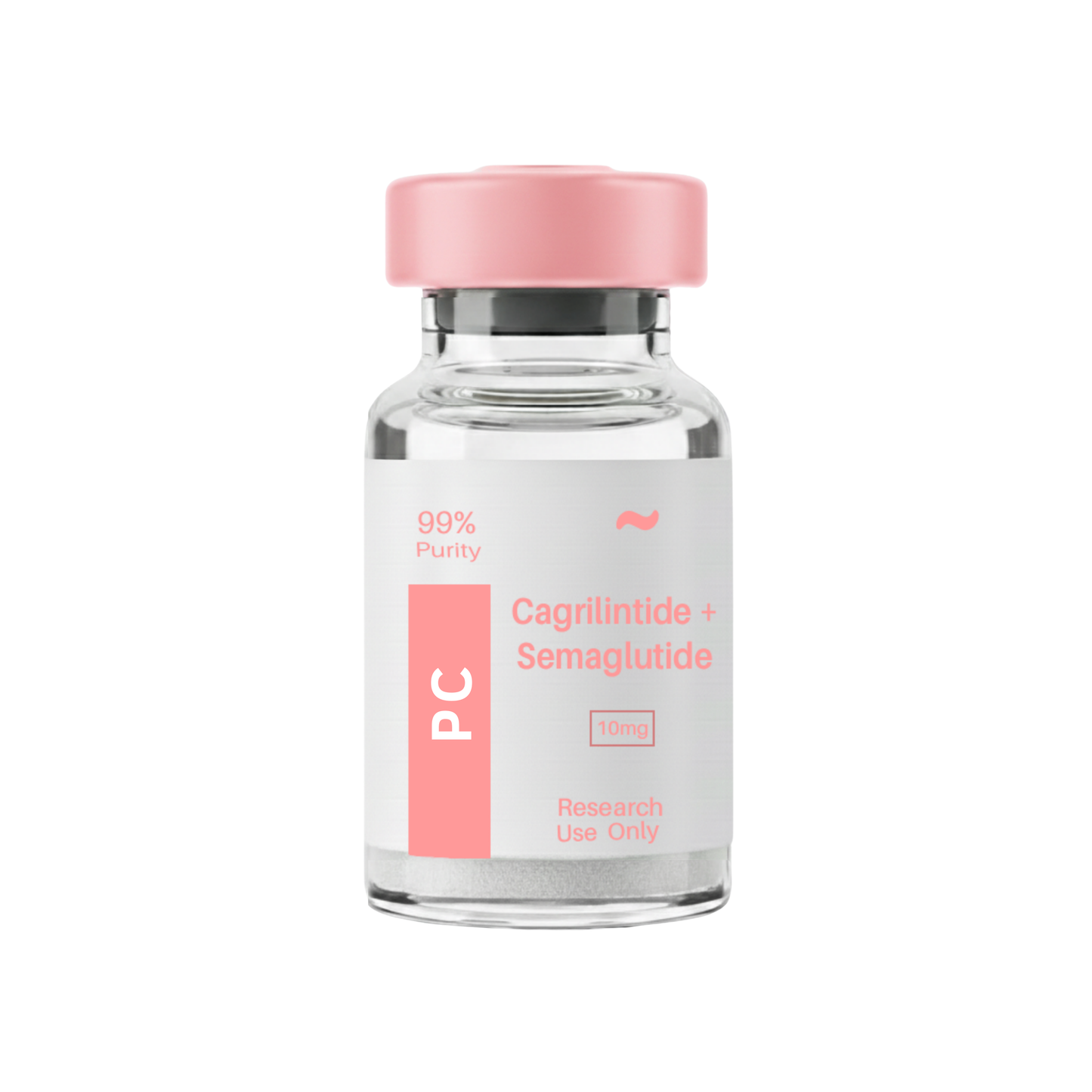
Cagrilintide + Semaglutide
This batch of Cagrilintide + Semaglutide Peptide Blend has been third party lab tested and verified for quality.
Contents: Cagrilintide (Amylin Analogue) + Semaglutide (GLP-1 Receptor Agonist) Combination
Form: Powder
Purity: 99.3%
Couldn't load pickup availability
Free Reconstitution Solution automatically added to your cart with each order.
This product is Made, Tested & Shipped From Canada.
Ships Today
Order by 1:00 PM EST
Free Shipping
For 2 or more vials
Verified+

Cagrilintide + Semaglutide Peptide Blend
The Cagrilintide + Semaglutide Peptide Blend combines two long-acting metabolic peptides into a single research formulation:
- Cagrilintide – an acylated amylin analogue and amylin receptor agonist
- Semaglutide – a selective GLP‑1 receptor agonist
This dual formulation is intended for laboratory studies of integrated appetite control, body‑weight regulation, and glucose metabolism. By activating both amylin and GLP‑1 receptor systems, the blend is used to investigate whether co‑agonism can:
- Produce greater and more sustained weight reduction than either peptide alone
- Enhance satiety and suppression of caloric intake
- Improve glycemic stability and related metabolic endpoints
Experimental models have reported:
- Decreases in daily caloric intake
- Improvements in fasting glucose, postprandial excursions, and composite glycemic markers
- Synergistic reductions in body weight, exceeding those observed with GLP‑1 or amylin analogues alone
These effects are hypothesized to arise from potentiated satiety signaling, slower gastric emptying, and complementary pancreatic and CNS actions.
Cagrilintide + Semaglutide Peptide Blend Overview
This dual-peptide blend is being utilized in research frameworks exploring:
- Visceral (central) adiposity
- Insulin sensitivity and beta‑cell function
- A broad array of cardiometabolic indicators, such as:
- Triglycerides, LDL‑C, HDL‑C
- Inflammatory markers (e.g., CRP, cytokine panels)
- Measures of hepatic metabolic function and fatty liver burden
Investigators aim to determine how concurrent amylin + GLP‑1 receptor activation influences:
- The trajectory and durability of weight loss
- Long-term body composition changes (fat mass vs. lean mass)
- Metabolic adaptation, including lowered resting metabolic rate, compensatory hunger, and neuroendocrine counter‑regulation
Longitudinal study designs typically:
- Control dietary intake to standardize caloric and macronutrient exposure
- Monitor CNS signaling dynamics in regions governing feeding and reward behavior
- Assess downstream consequences for:
- Energy expenditure and substrate utilization
- Glucose homeostasis (fasting, postprandial, HbA1c)
- Lipid turnover, including hepatic fat flux and adipose tissue function
This integrated approach allows detailed mapping of how dual hormonal inputs reconfigure the gut–brain–liver–adipose axis.
Cagrilintide + Semaglutide Peptide Blend Structure
Chemical Makeup
The product contains two synthetic peptide hormones, each targeting a distinct receptor class:
- Cagrilintide – amylin receptor agonist
- Semaglutide – GLP‑1 receptor agonist
Due to its dual-component composition and standard manufacturing variability, a single unified molecular formula for the blend is not provided. Instead, each lot is analytically characterized and certified.
Representative Batch Data (No. 2025007)
- Observed Mass (MS): 711.9 Da
- Purity (HPLC): 99.42%
- Batch Number: 2025007
- Primary Retention Time (HPLC): 3.48 min
- Instrument: LCMS‑7800 Series (calibrated)
- Analytical Note:
- Main chromatographic peak confirmed by retention time and mass spectrum
- One trace secondary peak (0.58% area) observed, within research‑grade impurity specifications
This analytical profile supports the identity, purity, and reproducibility of the formulation for laboratory use.
Cagrilintide + Semaglutide Peptide Blend Research
Combination Therapy and Weight Management
A principal rationale for this blend is the evaluation of combination peptide therapy for obesity and weight-regulation research. Dual amylin + GLP‑1 receptor agonism has been reported to:
- Produce larger weight reductions than GLP‑1 monotherapy (e.g., Semaglutide alone)
- Attenuate compensatory increases in appetite that often accompany weight loss
- Support maintenance of reduced body weight over extended periods in controlled trials
The combination leverages:
- Semaglutide’s potent GLP‑1–mediated satiety, insulinotropic activity, and glucagon suppression
- Cagrilintide’s amylin-like effects on meal size, gastric emptying, and glucagon feedback
Together, these actions enable investigation of reinforced suppression of energy intake and potential shifts in weight “setpoint” biology.
Glycemic Stability and Insulin Sensitivity
In type 2 diabetes and metabolic-dysregulation models, this blend is used to assess:
- Changes in HbA1c, reflecting chronic glycemic exposure
- Alterations in fasting plasma glucose and postprandial excursions
- Effects on insulin sensitivity, including:
- Reduced exogenous insulin requirements
- Improved beta‑cell functional markers
- Enhanced glucagon suppression after meals
Semaglutide contributes robust GLP‑1–driven glucose-lowering and insulinotropic effects, while Cagrilintide adds gastric‑emptying delay and additional glucagon modulation, together providing a framework for multi-layered glycemic control in experimental settings.
Visceral Adiposity and Lipid Profiles
The dual formulation is also employed to examine fat distribution and lipid metabolism, including:
- Quantification of visceral vs. subcutaneous fat via imaging (MRI, CT, DEXA)
- Serum measurements of:
- Triglycerides
- LDL‑C, HDL‑C, non‑HDL‑C
- Biomarkers of fatty acid oxidation and synthesis
The blend provides a model to test whether:
- Visceral adipose depots are preferentially reduced under dual agonism
- Improvements in lipid profiles exceed those attributable to weight loss alone, suggesting direct hepatic and adipose actions
Appetite Regulation and Meal Size
Appetite-focused research with Cagrilintide + Semaglutide evaluates:
- Subjective hunger and fullness scores
- Spontaneous caloric intake under ad libitum conditions
- Meal size, frequency, and temporal eating patterns
Reported findings include:
- More pronounced satiety and lower energy intake than with either peptide alone
- Reductions in snacking and preference for energy-dense foods
Mechanistically, these outcomes are linked to:
- GLP‑1 receptor activation in brainstem and hypothalamic nuclei
- Amylin receptor activation in the area postrema, NTS, and interconnected hypothalamic regions
This dual engagement facilitates detailed investigation of multi-pathway appetite and reward regulation.
Cardiometabolic Risk Factors
In long-term cardiometabolic research, the dual blend is used to monitor:
- Blood pressure, heart rate, and vascular markers
- Oxidative stress indicators and antioxidant defenses
- Systemic inflammatory and endothelial biomarkers
By:
- Reducing body weight and visceral adiposity
- Normalizing glycemia and lipid parameters
Cagrilintide + Semaglutide co‑agonism is hypothesized to lower overall cardiometabolic burden. Ongoing studies aim to quantify these effects and differentiate direct peptide actions from weight‑loss–mediated benefits.
Research Only
This Cagrilintide + Semaglutide Peptide Blend is intended solely for laboratory research by trained professionals.
It is not for use in humans or animals for therapeutic, diagnostic, or veterinary purposes.
Article Author
This review has been compiled, edited, and organized by Dr. Thue D. Müller, M.D., Ph.D.
Dr. Müller is a recognized leader in:
- Endocrinology and metabolic disorders
- Gut–brain peptide signaling
- Multi-agonist therapeutic strategies for obesity and type 2 diabetes
His work has focused extensively on:
- GLP‑1, GIP, and other incretin hormones
- Amylin analogues and dual amylin–GLP‑1 receptor agonists
Dr. Müller has played a central role in conceptualizing and characterizing dual agonist approaches similar to the Cagrilintide + Semaglutide paradigm, emphasizing integrated appetite and metabolic regulation.
Scientific Journal Author
Dr. Thue D. Müller has published widely on:
- The molecular and physiological mechanisms of GLP‑1 and GIP
- The design and evaluation of amylin analogues and co‑agonist peptides
In collaboration with:
- Dr. Jens J. Holst
- Dr. Richard D. DiMarchi
- Dr. Matthias H. Tschöp
- Dr. Christoffer Clemmensen
he has:
- Helped delineate how dual amylin + GLP‑1 receptor activation integrates within the gut–brain axis
- Clarified its impact on appetite, energy expenditure, and body‑weight regulation
- Explored implications for cardiometabolic risk reduction
His work in:
- Nature
- The Lancet
- Physiological Reviews
has significantly advanced current understanding of combined peptide therapies in metabolic research.
This acknowledgment is meant solely to recognize scientific contributions. It should not be interpreted as an endorsement of this product.
Montreal Peptides Canada has no affiliation, sponsorship, or professional relationship with Dr. Müller or any of the scientists cited.
Reference Citations
- Friedrichsen M, et al. Dual amylin and GLP‑1 receptor agonism for obesity research. Lancet. 2021;398(10295):2164–2176. PMID: 34895744.
https://pubmed.ncbi.nlm.nih.gov/34895744/ - Lau J, et al. Extended-action amylin analog and metabolic outcomes. Nature. 2021;597:1–6. PMID: 34497389.
https://pubmed.ncbi.nlm.nih.gov/34497389/ - Kushner RF, et al. Semaglutide for weight management: a controlled evaluation. N Engl J Med. 2021;384(11):989–1002. PMID: 33567185.
https://pubmed.ncbi.nlm.nih.gov/33567185/ - Müller TD, et al. Gut-brain peptide combination therapies in obesity. Physiol Rev. 2022;102(4):1889–1963. PMID: 35426549.
https://pubmed.ncbi.nlm.nih.gov/35426549/ - Arora T, et al. Amylin receptor signaling in feeding behavior regulation. Am J Physiol Gastrointest Liver Physiol. 2019;317(3):G429–G438. PMID: 31226682.
https://pubmed.ncbi.nlm.nih.gov/31226682/ - ClinicalTrials.gov Identifier: NCT04871225. Combined incretin and amylin analog therapy in obesity research.
https://clinicaltrials.gov/ct2/show/NCT04871225 - ClinicalTrials.gov Identifier: NCT05051579. Dual pathway metabolic intervention in type 2 diabetes.
https://clinicaltrials.gov/ct2/show/NCT05051579
HPLC / MS
HPLC
High-performance liquid chromatography (HPLC) is used to:
- Verify identity via characteristic retention time
- Confirm purity (~99.42% in the representative batch)
- Quantify impurity peaks and ensure they remain within acceptable limits
- Support batch-to-batch uniformity across production runs
MS
Mass spectrometry (MS) is applied to:
- Confirm the observed molecular mass (e.g., 711.9 Da for the principal component)
- Provide orthogonal confirmation of HPLC peak identity
- Detect any low-level secondary or degradation products
Together, HPLC and MS provide a comprehensive quality-control framework for characterization of this dual-peptide blend.
STORAGE
Storage Instructions
The Cagrilintide + Semaglutide Peptide Blend is supplied as a lyophilized (freeze-dried) powder:
- Stable for approximately 3–4 months during shipping and short-term room-temperature storage
- After reconstitution with bacteriostatic water, store at ~4°C (39°F)
- Once reconstituted, the solution is generally stable for up to 30 days when refrigerated
Lyophilization Process
- The peptide mixture is frozen and subjected to reduced pressure, causing water to sublimate
- This yields a dry, white crystalline powder with enhanced stability
For long-term storage:
- Maintain lyophilized vials at −80°C (−112°F)
- This temperature best preserves peptide structure and activity
Upon receipt:
- Keep vials cool and shielded from light
- For short-term use (days–weeks), refrigeration below 4°C (39°F) is typically sufficient
- For optimal shelf life, refrigerated or frozen storage is preferred over room temperature
Best Practices for Storing Peptides
To maintain peptide quality and ensure reliable data:
- Store in a cold, dry, dark environment
- Avoid repeated freeze–thaw cycles
- Minimize exposure to air (oxygen) and humidity
- Protect from light, particularly UV
- Keep peptides lyophilized for as long as feasible; reconstitute as close to use as practical
- Aliquot into smaller vials according to experimental needs to reduce handling and exposure
Preventing Oxidation and Moisture Contamination
Oxidation and moisture are major contributors to peptide degradation:
- When removing vials from frozen storage, allow them to warm to room temperature before opening to prevent condensation
- Limit the time each vial remains open; reseal immediately after use
- If possible, store remaining material under a dry, inert gas atmosphere (e.g., nitrogen or argon)
These precautions are especially important for sequences containing:
- Cysteine (C)
- Methionine (M)
- Tryptophan (W)
which are particularly prone to oxidative damage.
To further preserve peptide integrity:
- Minimize thaw–refreeze events
- Prepare single-use or short-term aliquots whenever feasible
Storing Peptides in Solution
Peptides in solution are more susceptible than lyophilized forms to:
- Microbial contamination
- Hydrolytic and oxidative degradation
This is especially true for peptides containing Cys, Met, Trp, Asp, Gln, or N-terminal Glu.
If solution storage is necessary:
- Use sterile buffers with pH between 5 and 6, unless otherwise required by the protocol
- Divide into aliquots to limit repeated freezing and thawing
- Under refrigeration at 4°C (39°F), most peptide solutions remain stable for up to 30 days
- Peptides known to be especially labile should be stored frozen when not in active use
Peptide Storage Containers
Container selection also influences peptide stability:
- Use containers that are clean, chemically inert, and appropriately sized to minimize headspace
- Suitable options include:
- Glass vials – high chemical resistance and stability; ideal for long-term storage
- Plastic vials:
- Polystyrene – clear and easy to inspect visually, but less chemically resistant
- Polypropylene – more chemically durable, typically translucent
Peptides are often shipped in plastic vials to reduce breakage risk and may be transferred to glass for extended storage if desired.
Peptide Storage Guidelines: General Tips
To preserve the Cagrilintide + Semaglutide Peptide Blend:
- Store in a cool, dry, dark environment
- Avoid unnecessary temperature cycling
- Minimize air and moisture exposure
- Protect from direct and UV light
- Prefer lyophilized storage and reconstitute only when required
- Align your aliquoting strategy with experimental schedules to reduce handling and preserve potency
-

HIGHEST QUALITY PEPTIDES
Our products are scientifically formulated and manufactured in cGMP-compliant facilities.
-

FAST DELIVERY
Enjoy fast and reliable 3–5 day shipping.
-

Dedicated Customer Service
Our customer service team is highly knowledgeable in peptide research and its applications. We’re available 24/7 to assist you.
You may also like
-
SAVE 23%HCG - Research Grade Peptide Hormone
Regular price From $72.00Regular price From $72.00 Sale priceUnit price / per$94.0023% -
SAVE 25%Tirzepatide
Regular price From $50.00Regular price From $50.00 Sale priceUnit price / per$67.0025% -
SAVE 24%Thymosin Alpha-1
Regular price From $79.00Regular price From $79.00 Sale priceUnit price / per$104.0024% -
SAVE 23%Tesamorelin
Regular price From $80.00Regular price From $80.00 Sale priceUnit price / per$105.0023% -
SAVE 23%Survodutide
Regular price $299.00Regular price $299.00 Sale priceUnit price / per$392.0023% -
SAVE 26%Sterile Water
Regular price From $14.00Regular price From $14.00 Sale priceUnit price / per$19.0026% -
SAVE 23%SLU-PP-332
Regular price $125.00Regular price $125.00 Sale priceUnit price / per$164.0023% -
SAVE 23%Sermorelin
Regular price From $70.00Regular price From $70.00 Sale priceUnit price / per$92.0023% -
SAVE 23%Semaglutide
Regular price From $36.00Regular price From $36.00 Sale priceUnit price / per$47.0023% -
SAVE 23%Retatrutide Triple Agonist
Regular price From $90.00Regular price From $90.00 Sale priceUnit price / per$118.0023% -
SAVE 26%Oxytocin Acetate
Regular price $42.00Regular price $42.00 Sale priceUnit price / per$57.0026% -
SAVE 25%Melanotan II (MT2)
Regular price $50.00Regular price $50.00 Sale priceUnit price / per$67.0025% -
SAVE 24%Lipo-C with B Vitamins
Regular price $85.00Regular price $85.00 Sale priceUnit price / per$112.0024% -
SAVE 23%L-Carnitine
Regular price $97.00Regular price $97.00 Sale priceUnit price / per$127.0023% -
SAVE 23%Lemon Bottle 10mg
Regular price $80.00Regular price $80.00 Sale priceUnit price / per$105.0023% -
SAVE 24%KPV Tripeptide
Regular price From $56.00Regular price From $56.00 Sale priceUnit price / per$74.0024% -
KLOW Blend - GHK-CU + TB-500 + BPC-157 + KPV 10mg
Regular price $200.00Regular price $200.00 Sale priceUnit price / per$261.0023% -
Kisspeptin-10 - Premium Research Peptide
Regular price From $65.00Regular price From $65.00 Sale priceUnit price / per$85.0023% -
SAVE 23%Ipamorelin
Regular price From $32.00Regular price From $32.00 Sale priceUnit price / per$42.0023% -
SAVE 24%IGF-1 LR3 (Long R3)
Regular price From $40.00Regular price From $40.00 Sale priceUnit price / per$53.0024% -
SAVE 24%HMG 75iu - Premium Research Peptide
Regular price $80.00Regular price $80.00 Sale priceUnit price / per$106.0024% -
SAVE 24%Hyaluronic
Regular price $28.00Regular price $28.00 Sale priceUnit price / per$37.0024% -
SAVE 23%HGH Fragment 176-191
Regular price $97.00Regular price $97.00 Sale priceUnit price / per$127.0023% -
SAVE 23%HGH 191AA (Somatropin)
Regular price From $55.00Regular price From $55.00 Sale priceUnit price / per$72.0023% -
SAVE 23%HCG - Premium Research Peptide
Regular price From $72.00Regular price From $72.00 Sale priceUnit price / per$94.0023% -
Gonadorelin - Premium Research Peptide
Regular price $50.00Regular price $50.00 Sale priceUnit price / per$67.0025% -
SAVE 23%Glutathione
Regular price From $75.00Regular price From $75.00 Sale priceUnit price / per$98.0023% -
SAVE 23%Glow BPC-157 + GHK-CU + TB-500
Regular price $139.00Regular price $139.00 Sale priceUnit price / per$181.0023%
Every vial we sell comes from a lab that follows current Good Manufacturing Practices (cGMP). That means each step of production is documented and controlled. Before a batch is released, it’s tested by independent third-party labs for purity, identity, and sterility. Certificates of analysis are available so you can see the exact test results.
Yes. The labs we work with use ISO-certified clean rooms where air quality, equipment, and handling procedures are tightly regulated. Staff are trained to pharmaceutical-grade standards. This ensures the peptides are produced in an environment that minimizes contamination risks.
Peptides in lyophilized (freeze-dried) form are stable at room temperature for transport. Once you receive them, refrigeration is recommended to maintain long-term integrity. We package every order securely to prevent damage and ship promptly, so your vials arrive in optimal condition.
We operate under strict in-house protocols that follow current Good Manufacturing Practices (cGMP). That means our team oversees the entire process from sourcing raw amino acids to the final lyophilized vial. Nothing is outsourced or repackaged. This gives us full control over purity, consistency, and sterility, and it’s why we can stand behind every single vial we ship.
Store them in the refrigerator, away from direct light and heat. If you need to keep them longer, some peptides can be stored frozen. Each vial comes with clear handling instructions so you know the proper conditions for stability.
The strongest proof is transparency. For every peptide, we can provide certificates of analysis, manufacturing documentation, and references to the published scientific research behind it. If you ever have questions, we’ll show you the data rather than ask you to take our word for it.
The difference is transparency. Most sites give you a product name and a price. We provide full batch testing, lab documentation, and direct access to certificates of analysis so you don’t have to guess what you’re getting. When you order from us, you know exactly what’s in the vial, where it was made, and how it was verified.