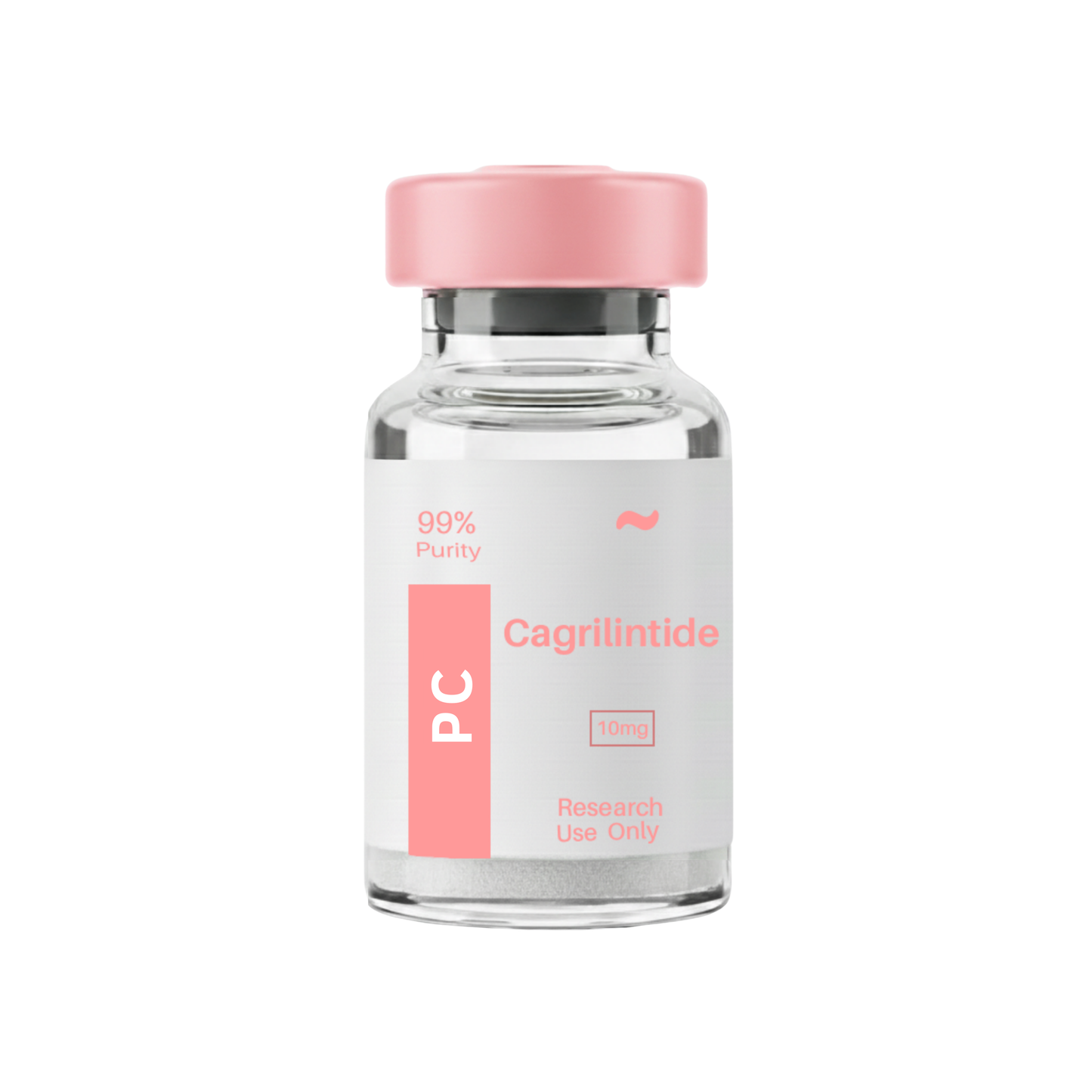
Cagrilintide
Cagrilintide
This batch of Cagrilintide Peptide has been third party lab tested and verified for quality.
Contents: Cagrilintide (Amylin Analogue, Long-Acting Appetite Regulator)
Form: Powder
Purity: 99.3%
Couldn't load pickup availability
Free Reconstitution Solution automatically added to your cart with each order.
This product is Made, Tested & Shipped From Canada.
Ships Today
Order by 1:00 PM EST
Free Shipping
For 2 or more vials
Verified+

Cagrilintide
Cagrilintide is a synthetically acylated peptide developed as a long-acting agonist at amylin receptors. Under normal physiological conditions, amylin is co-secreted with insulin from pancreatic beta cells and plays a central role in terminating meals, slowing gastric emptying, and smoothing postprandial glucose excursions.
Within metabolic and obesity research, Cagrilintide is used to explore whether sustained amylin receptor activation can:
- Lower total energy intake by reducing hunger and limiting meal size
- Strengthen satiety signaling along gut–brain pathways
- Help maintain metabolic equilibrium, influencing body weight, fat distribution, and glycemic control
Research programs focus on Cagrilintide’s effects within amylin-responsive regions of the central nervous system, especially:
- Hypothalamic nuclei, which integrate hormonal and nutrient signals into hunger/satiety output
- Brainstem areas, which coordinate visceral feedback and autonomic responses related to feeding
Controlled preclinical and clinical studies are being used to determine whether chronic exposure to Cagrilintide can:
- Sustain durable reductions in calorie intake
- Retard gastric emptying, transforming the shape of the post-meal glucose curve
- Alter body weight trajectories, visceral adipose mass, and cardiometabolic biomarkers in obesity and insulin resistance models
Cagrilintide Overview
Cagrilintide is being evaluated as a multi-axis regulator of energy and glucose metabolism, with research particularly focused on:
- Reduction in central (visceral) adiposity
- Improved postprandial and fasting glycemia
- Possible downstream benefits for cardiometabolic risk, such as blood pressure, lipid profile, and insulin sensitivity
Available data suggest that Cagrilintide:
- Modifies feeding patterns, by intensifying internal satiety cues and dampening hyperphagic, reward-driven intake
- Influences energy balance, by linking changes in appetite to downstream nutrient handling and storage
One of the most active areas of investigation concerns its combination with incretin-based therapies, notably GLP‑1 receptor agonists:
- Cagrilintide’s amylin receptor signaling appears to work in synergy with GLP‑1 pathways
- Co-administration with GLP‑1 analogues such as semaglutide has demonstrated greater weight loss and improved glycemic outcomes than monotherapy in structured research settings
Concurrently, teams are examining Cagrilintide’s impact on:
- Hypothalamic integration centers (e.g., arcuate nucleus), which orchestrate hunger and satiety
- Brainstem and reward-related neural networks, which modulate cravings, food seeking, and hedonic aspects of feeding
Altogether, these lines of evidence position Cagrilintide as a potential cornerstone peptide for studying long-term obesity management, complex metabolic disease, and rational multi-peptide intervention strategies.
Cagrilintide Structure
Structurally, Cagrilintide is a sequence-modified, acylated analogue of human amylin. Its design incorporates several key features:
- Strategic amino acid substitutions that enhance resistance to proteolytic degradation
- An acyl group that promotes binding to plasma proteins, significantly prolonging systemic exposure
- Modifications specifically intended to reduce the amyloidogenic potential characteristic of native amylin
These structural refinements allow Cagrilintide to:
- Maintain strong agonist activity at amylin receptors
- Achieve a long plasma half-life, compatible with extended dosing intervals in research designs
- Minimize the formation of insoluble amyloid fibrils and associated cytotoxicity relative to wild-type amylin
In essence, Cagrilintide’s molecular architecture is optimized to deliver durable amylin-like effects with a more favorable pharmacokinetic and aggregation profile.
Cagrilintide Research
Cagrilintide Origin: Understanding Amylin
The rationale for Cagrilintide stems from the physiological roles of amylin (islet amyloid polypeptide, IAPP):
- Secreted along with insulin from pancreatic beta cells
- Synthesized initially as an 89–amino acid propeptide
- Cleaved to form an active, 37–amino acid hormone
Amylin is typically co-released at about a 100:1 ratio relative to insulin and fulfills multiple complementary roles:
- Delays gastric emptying, prolonging the presence of nutrients in the stomach
- Promotes satiety, helping to limit meal size and caloric load
- Diminishes postprandial glucose spikes by retarding nutrient flux from stomach to intestine
Together, these effects:
- Fine-tune post-meal carbohydrate metabolism
- Favor the utilization of glucose for immediate energy, reducing rapid diversion into adipose storage
Amylin also participates in bone and mineral homeostasis, and shows close structural and functional kinship with:
- Calcitonin
- Calcitonin gene-related peptide (CGRP)
These related peptides:
- Contribute to calcium balance
- Encourage calcium incorporation into bone
- Lower circulating calcium levels
Amylin is thought to influence renal calcium handling as well. Overall, it may support:
- Bone mineralization
- Defense against bone loss and resorption
What Is Cagrilintide?
Cagrilintide is a long-acting amylin receptor agonist designed to preserve the beneficial effects of amylin while overcoming its principal drawbacks.
Two major challenges with native amylin inspired its redesign:
- Short Half-Life and Proteolysis
- Native amylin is rapidly degraded by proteases in the bloodstream
- Cagrilintide incorporates sequence changes and acylation that substantially extend its half-life, enabling more sustained receptor activation
- Intrinsic Amyloidogenicity
- At elevated concentrations, wild-type amylin can self-assemble into insoluble amyloid fibrils
- These aggregates:
- Are linked to beta-cell damage and reduced insulin secretory capacity
- Contribute to type 2 diabetes progression via islet amyloid deposition
- Structurally, amylin fibrils are reminiscent of amyloid‑β plaques seen in Alzheimer’s disease, underscoring shared mechanisms in amyloid toxicity
Chronic overnutrition and sustained hyperinsulinemia/hyperamylinemia can increase aggregation risk. Cagrilintide was engineered to retain metabolic advantages of amylin signaling while markedly limiting fibril formation.
Before Cagrilintide, pramlintide was developed as the first clinically used amylin analogue:
- Employed as an adjunct therapy to insulin in diabetes
- Helps flatten postprandial glucose excursions
- Enables lower insulin dose requirements and smoother glycemic control
Cagrilintide extends beyond pramlintide by offering:
- A much longer pharmacokinetic profile
- Improved practicality for chronic obesity and weight-management research
Crucially, Cagrilintide interacts with receptors governed by receptor activity–modifying proteins (RAMPs). These accessory proteins pair with G-protein–coupled receptors (GPCRs) to adjust receptor properties:
- RAMP‑1 and RAMP‑3 combine with:
- Calcitonin-like receptor (CLR)
- Calcitonin receptor
- Calcium-sensing receptor
- RAMP‑3 additionally associates with the secretin receptor
These complexes influence:
- Ligand specificity and affinity
- Intracellular signaling cascades
- Tissue- and context-specific biological outcomes
Disturbances in RAMP pathways have been associated with:
- Cardiovascular disease
- Diabetes and related metabolic disturbances
- Some cancers
Cagrilintide’s in vivo profile is therefore shaped by interactions within this amylin–RAMP–GPCR regulatory network.
How Cagrilintide Works
Cagrilintide exerts multifaceted actions across gastrointestinal, central nervous, and endocrine systems.
1. Gastrointestinal Actions
In the GI tract, Cagrilintide:
- Slows gastric emptying, retaining ingested food in the stomach for longer periods
- Prolongs gastric distension and modulates proximal intestinal transit
- Enhances afferent signaling from the GI tract to the brain’s satiety centers
Functionally, these actions:
- Result in smaller meals and reduced daily caloric intake in metabolic models
- Flatten post-meal glucose peaks, as nutrient absorption is spread out over time
- Provide more opportunity for tissues to clear and metabolize glucose, limiting rapid conversion to lipid
2. Central Nervous System (CNS) Effects
In the CNS, Cagrilintide targets amylin receptor–expressing sites within:
- The arcuate nucleus and other parts of the hypothalamus
- Brainstem regions, such as the area postrema and nucleus tractus solitarius
Through these central circuits, Cagrilintide:
- Potentiates satiety signaling, encouraging earlier voluntary meal termination
- Modulates hedonic and reward-oriented feeding pathways, attenuating cravings and compulsive intake
- Shifts the internal balance from hyperphagic drive toward more controlled, regulated eating behavior
The net CNS effect is a dampening of appetite and reward-based overeating, an important component of its weight-modulating profile in research.
3. Pancreatic and Hormonal Feedback
Cagrilintide also mimics amylin’s role in islet hormone cross-talk by:
- Supporting suppression of glucagon release in the postprandial window
- Reducing hepatic glucose output, particularly after meals
- Helping to optimize the balance between:
- Tissue-level glucose uptake and utilization
- Storage of surplus carbohydrates as fat
Collectively, these GI, CNS, and pancreatic actions make Cagrilintide a valuable tool to study coordinated regulation of appetite, glucose profiles, and adipose storage.
Cagrilintide Summary
In summary, Cagrilintide is a long-acting, structurally optimized amylin receptor agonist with dual emphasis on:
- Slowing gastric emptying and nutrient delivery
- Strengthening central satiety and reducing hyperphagia
Current research indicates that:
- As a monotherapy, Cagrilintide can produce substantial weight loss, in certain models surpassing the effects of GLP‑1 receptor agonists such as semaglutide
- When used in combination (e.g., Cagrilintide + semaglutide), the peptides often demonstrate additive or synergistic effects, reflected in:
- Enhanced body-weight reduction
- Improved glycemic control
- Potentially more favorable changes in cardiometabolic parameters
Preliminary and mechanistic work further suggests that Cagrilintide may have relevance in:
- Cardiovascular research, particularly in the context of obesity- and diabetes-related risk
- Neurodegenerative disease models, including Alzheimer’s disease, due to overlapping themes in amylin–amyloid biology in both pancreatic and CNS tissues
These extended applications remain exploratory and are not yet established clinical indications.
Article Author
This literature-based review was compiled and organized by Dr. Jens J. Holst, M.D., Ph.D., an internationally recognized expert in:
- Endocrine physiology and metabolic regulation
- Gut hormone and incretin biology
- Amylin and GLP‑1 analogue pharmacology
Dr. Holst’s research has been instrumental in clarifying how peptide hormones such as GLP‑1, GIP, and amylin analogues:
- Govern appetite and satiety mechanisms
- Coordinate energy expenditure and glucose homeostasis
- Provide a conceptual basis for peptide-based strategies in obesity and diabetes, including the research use of Cagrilintide.
Scientific Journal Author
Dr. Jens J. Holst has published widely on:
- The physiology, clinical pharmacology, and therapeutic use of GLP‑1 receptor agonists
- The mechanistic and translational aspects of amylin receptor agonists, focusing on their impacts on:
- Meal size and satiety
- Gastric motility and emptying
- Glycemic profiles and body weight
In collaboration with J. Lau, M. Friedrichsen, C.J. Bailey, E.P. Smith, and others, Dr. Holst has:
- Dissected how combined incretin–amylin signaling modulates CNS and peripheral metabolic circuits
- Demonstrated how these peptide pathways can enhance weight-loss outcomes and metabolic improvements
- Contributed to defining Cagrilintide’s mechanism and its synergy with GLP‑1 analogues, particularly semaglutide
This body of work has appeared in high-impact journals, including:
- Nature
- The Lancet
- Diabetes, Obesity and Metabolism
This acknowledgment is provided solely to recognize the scientific contributions of Dr. Holst and colleagues. It should not be interpreted as product endorsement. Montreal Peptides Canada has no affiliation, sponsorship, or financial relationship with Dr. Holst or any co-authors mentioned.
Reference Citations
- Lau J, et al. Cagrilintide, a long-acting amylin analog for metabolic research. Nature. 2021;597(7878):1–6. PMID: 34497389.
https://pubmed.ncbi.nlm.nih.gov/34497389/ - Bailey CJ. Amylin analogs for obesity research: mechanisms and outcomes. Diabetes Obes Metab. 2021;23(2):375–384. PMID: 33022756.
https://pubmed.ncbi.nlm.nih.gov/33022756/ - Friedrichsen M, et al. Cagrilintide in obesity: controlled evaluation in metabolic models. Lancet. 2021;398(10295):2164–2176. PMID: 34895744.
https://pubmed.ncbi.nlm.nih.gov/34895744/ - Smith EP, et al. CNS modulation of meal size by amylin receptor agonism. Endocr Rev. 2020;41(5):bnz014. PMID: 31830242.
https://pubmed.ncbi.nlm.nih.gov/31830242/ - Arora T, et al. Gastric emptying and satiety regulation via amylin signaling. Am J Physiol Gastrointest Liver Physiol. 2019;317(3):G429–G438. PMID: 31226682.
https://pubmed.ncbi.nlm.nih.gov/31226682/ - Jensen EP, et al. Multimodal metabolic effects of amylin receptor agonists. J Clin Endocrinol Metab. 2022;107(1):e153–e164. PMID: 34425844.
https://pubmed.ncbi.nlm.nih.gov/34425844/ - ClinicalTrials.gov Identifier: NCT03586876. Cagrilintide evaluation in metabolic obesity research.
https://clinicaltrials.gov/ct2/show/NCT03586876 - ClinicalTrials.gov Identifier: NCT03896288. Amylin analog studies in weight reduction models.
https://clinicaltrials.gov/ct2/show/NCT03896288
HPLC / MS
HPLC
High-performance liquid chromatography (HPLC) is used to:
- Confirm the identity of Cagrilintide
- Quantify purity and measure trace impurities or degradation products
- Provide batch-to-batch consistency data for research applications
MS
Mass spectrometry (MS) is employed to:
- Verify the expected molecular weight of Cagrilintide
- Supply additional confirmation of structural integrity
- Detect any chemical modifications or breakdown species over time
Together, HPLC and MS form a rigorous analytical quality-control platform for this peptide.
STORAGE
Storage Instructions
Cagrilintide is provided as a lyophilized (freeze-dried) powder to maintain stability:
- In its lyophilized state, it is typically stable for 3–4 months during shipping and short-term room-temperature storage
- After reconstitution with bacteriostatic water, vials should be stored in a refrigerator (~4°C / 39°F)
- Once reconstituted, Cagrilintide is generally stable for up to 30 days when kept under refrigeration
The lyophilization (cryodesiccation) process:
- Freezes the peptide material
- Uses low pressure to drive water directly from ice to vapor (sublimation)
- Yields a dry, white crystalline powder with improved shelf life compared to solutions
For long-term storage (months to years):
- Maintain lyophilized vials at −80°C (−112°F)
- This temperature range best preserves the peptide’s conformation and bioactivity
Upon receipt:
- Keep vials cool and protected from direct light
- For short- to mid-term use (days to a few months), refrigeration below 4°C (39°F) is appropriate
- While lyophilized peptides can tolerate room temperature for several weeks, chilled or frozen storage is recommended for maximum stability
Best Practices for Storing Peptides
To maximize peptide integrity and ensure reproducible experimental data:
- Store in a cool, dry, dark location
- Avoid repeated freeze–thaw cycles
- Minimize exposure to air (oxygen) and moisture
- Keep peptides in lyophilized form until shortly before use
- Allocate product into small, single-use or limited-use aliquots to reduce handling
Preventing Oxidation and Moisture Contamination
Both oxygen and water can accelerate peptide degradation:
- When removing vials from frozen storage, allow them to warm to room temperature before opening to prevent condensation
- Limit the duration that vials remain open; reseal promptly after aliquoting
- When possible, store partially used vials under a dry inert gas atmosphere (e.g., nitrogen or argon) to further mitigate oxidation
These precautions are particularly important for peptides rich in:
- Cysteine (C)
- Methionine (M)
- Tryptophan (W)
which are highly susceptible to oxidative modifications.
To further reduce degradation:
- Minimize thaw–refreeze events
- Use pre-portioned aliquots designed around experimental needs
Storing Peptides in Solution
Compared with lyophilized powders, peptide solutions are more vulnerable to:
- Microbial contamination
- Chemical breakdown through hydrolysis and oxidation
Sequences containing Cys, Met, Trp, Asp, Gln, or N-terminal Glu are particularly unstable in solution.
If storing peptides in solution is unavoidable:
- Use sterile buffers within a pH range of 5–6
- Divide solutions into smaller aliquots to limit freeze–thaw exposure
- At 4°C (39°F), most peptide solutions remain viable for up to 30 days
- For more sensitive peptides, consider frozen storage whenever they are not actively in use
Peptide Storage Containers
Proper container selection enhances peptide stability:
- Containers should be chemically inert, clean, and appropriately sized to minimize internal air volume
- Suitable materials include:
- Glass vials – chemically stable, clear, ideal for long-term storage
- Plastic vials:
- Polystyrene – clear and easy to inspect, but less chemically resistant
- Polypropylene – more chemically resistant, typically translucent
Peptides are commonly shipped in plastic vials to prevent breakage during transport, but can be transferred to glass for long-term storage if desired.
Peptide Storage Guidelines: General Tips
To preserve peptides such as Cagrilintide:
- Store in a cold, dry, dark environment
- Avoid unnecessary temperature fluctuations
- Reduce contact with air and humidity
- Protect from light, especially UV exposure
- Favor lyophilized storage and reconstitute only when needed
- Plan aliquoting and usage to limit handling and extend shelf life
-

HIGHEST QUALITY PEPTIDES
Our products are scientifically formulated and manufactured in cGMP-compliant facilities.
-

FAST DELIVERY
Enjoy fast and reliable 3–5 day shipping.
-

Dedicated Customer Service
Our customer service team is highly knowledgeable in peptide research and its applications. We’re available 24/7 to assist you.
You may also like
-
SAVE 23%HCG - Research Grade Peptide Hormone
Regular price From $72.00Regular price From $72.00 Sale priceUnit price / per$94.0023% -
SAVE 25%Tirzepatide
Regular price From $50.00Regular price From $50.00 Sale priceUnit price / per$67.0025% -
SAVE 24%Thymosin Alpha-1
Regular price From $79.00Regular price From $79.00 Sale priceUnit price / per$104.0024% -
SAVE 23%Tesamorelin
Regular price From $80.00Regular price From $80.00 Sale priceUnit price / per$105.0023% -
SAVE 23%Survodutide
Regular price $299.00Regular price $299.00 Sale priceUnit price / per$392.0023% -
SAVE 26%Sterile Water
Regular price From $14.00Regular price From $14.00 Sale priceUnit price / per$19.0026% -
SAVE 23%SLU-PP-332
Regular price $125.00Regular price $125.00 Sale priceUnit price / per$164.0023% -
SAVE 23%Sermorelin
Regular price From $70.00Regular price From $70.00 Sale priceUnit price / per$92.0023% -
SAVE 23%Semaglutide
Regular price From $36.00Regular price From $36.00 Sale priceUnit price / per$47.0023% -
SAVE 23%Retatrutide Triple Agonist
Regular price From $90.00Regular price From $90.00 Sale priceUnit price / per$118.0023% -
SAVE 26%Oxytocin Acetate
Regular price $42.00Regular price $42.00 Sale priceUnit price / per$57.0026% -
SAVE 25%Melanotan II (MT2)
Regular price $50.00Regular price $50.00 Sale priceUnit price / per$67.0025% -
SAVE 24%Lipo-C with B Vitamins
Regular price $85.00Regular price $85.00 Sale priceUnit price / per$112.0024% -
SAVE 23%L-Carnitine
Regular price $97.00Regular price $97.00 Sale priceUnit price / per$127.0023% -
SAVE 23%Lemon Bottle 10mg
Regular price $80.00Regular price $80.00 Sale priceUnit price / per$105.0023% -
SAVE 24%KPV Tripeptide
Regular price From $56.00Regular price From $56.00 Sale priceUnit price / per$74.0024% -
KLOW Blend - GHK-CU + TB-500 + BPC-157 + KPV 10mg
Regular price $200.00Regular price $200.00 Sale priceUnit price / per$261.0023% -
Kisspeptin-10 - Premium Research Peptide
Regular price From $65.00Regular price From $65.00 Sale priceUnit price / per$85.0023% -
SAVE 23%Ipamorelin
Regular price From $32.00Regular price From $32.00 Sale priceUnit price / per$42.0023% -
SAVE 24%IGF-1 LR3 (Long R3)
Regular price From $40.00Regular price From $40.00 Sale priceUnit price / per$53.0024% -
SAVE 24%HMG 75iu - Premium Research Peptide
Regular price $80.00Regular price $80.00 Sale priceUnit price / per$106.0024% -
SAVE 24%Hyaluronic
Regular price $28.00Regular price $28.00 Sale priceUnit price / per$37.0024% -
SAVE 23%HGH Fragment 176-191
Regular price $97.00Regular price $97.00 Sale priceUnit price / per$127.0023% -
SAVE 23%HGH 191AA (Somatropin)
Regular price From $55.00Regular price From $55.00 Sale priceUnit price / per$72.0023% -
SAVE 23%HCG - Premium Research Peptide
Regular price From $72.00Regular price From $72.00 Sale priceUnit price / per$94.0023% -
Gonadorelin - Premium Research Peptide
Regular price $50.00Regular price $50.00 Sale priceUnit price / per$67.0025% -
SAVE 23%Glutathione
Regular price From $75.00Regular price From $75.00 Sale priceUnit price / per$98.0023% -
SAVE 23%Glow BPC-157 + GHK-CU + TB-500
Regular price $139.00Regular price $139.00 Sale priceUnit price / per$181.0023%
Every vial we sell comes from a lab that follows current Good Manufacturing Practices (cGMP). That means each step of production is documented and controlled. Before a batch is released, it’s tested by independent third-party labs for purity, identity, and sterility. Certificates of analysis are available so you can see the exact test results.
Yes. The labs we work with use ISO-certified clean rooms where air quality, equipment, and handling procedures are tightly regulated. Staff are trained to pharmaceutical-grade standards. This ensures the peptides are produced in an environment that minimizes contamination risks.
Peptides in lyophilized (freeze-dried) form are stable at room temperature for transport. Once you receive them, refrigeration is recommended to maintain long-term integrity. We package every order securely to prevent damage and ship promptly, so your vials arrive in optimal condition.
We operate under strict in-house protocols that follow current Good Manufacturing Practices (cGMP). That means our team oversees the entire process from sourcing raw amino acids to the final lyophilized vial. Nothing is outsourced or repackaged. This gives us full control over purity, consistency, and sterility, and it’s why we can stand behind every single vial we ship.
Store them in the refrigerator, away from direct light and heat. If you need to keep them longer, some peptides can be stored frozen. Each vial comes with clear handling instructions so you know the proper conditions for stability.
The strongest proof is transparency. For every peptide, we can provide certificates of analysis, manufacturing documentation, and references to the published scientific research behind it. If you ever have questions, we’ll show you the data rather than ask you to take our word for it.
The difference is transparency. Most sites give you a product name and a price. We provide full batch testing, lab documentation, and direct access to certificates of analysis so you don’t have to guess what you’re getting. When you order from us, you know exactly what’s in the vial, where it was made, and how it was verified.