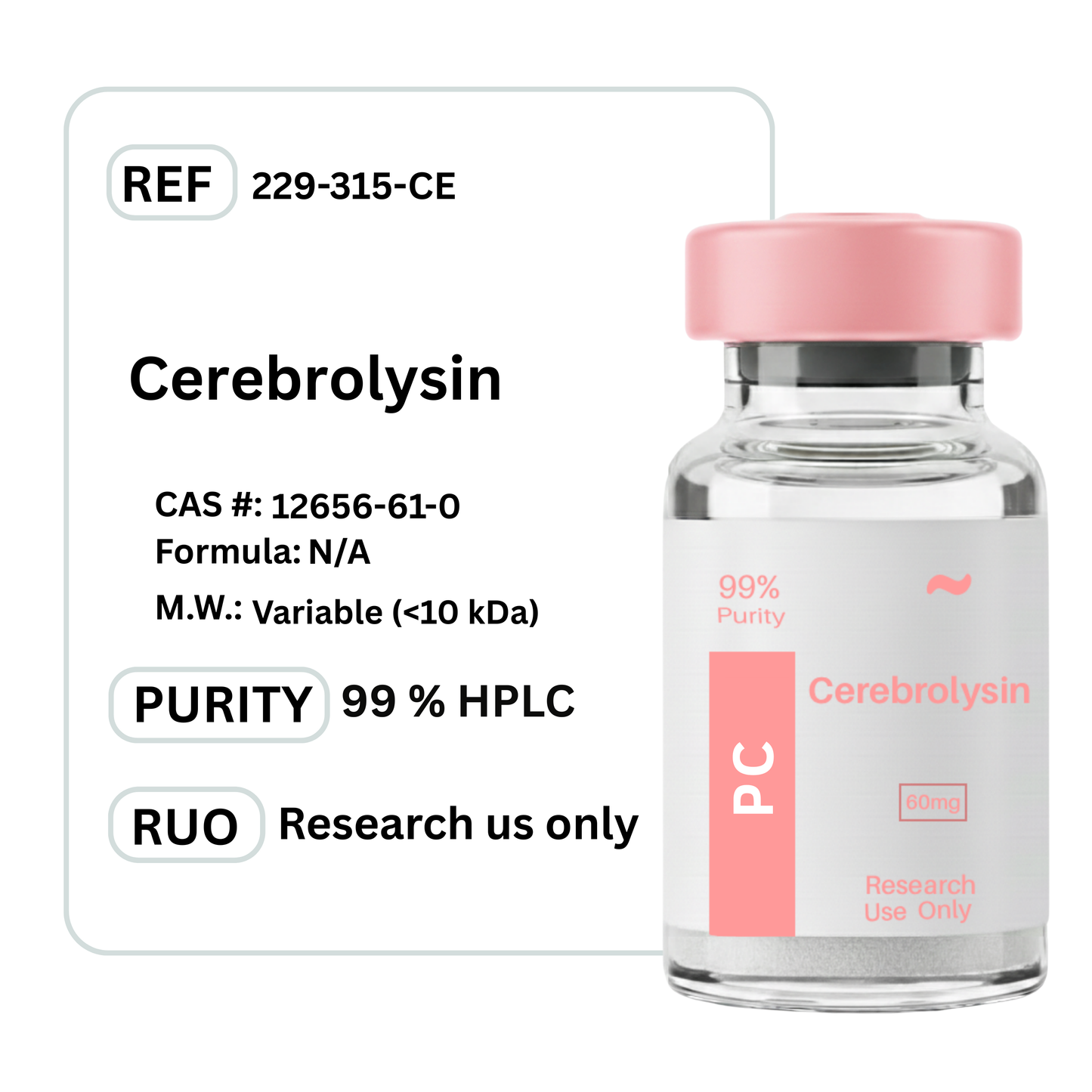
Cerebrolysin
Cerebrolysin
This batch of Cerebrolysin Peptide has been third party lab tested and verified for quality.
Contents: Cerebrolysin (Neuropeptide and Amino Acid Complex)
Form: Matrix: Powder
Purity: 99.3%
Couldn't load pickup availability
Free Reconstitution Solution automatically added to your cart with each order.
This product is Made, Tested & Shipped From Canada.
Ships Today
Order by 1:00 PM EST
Free Shipping
For 2 or more vials
Verified+

Cerebrolysin
Cerebrolysin is a neurotrophic peptide complex of biological origin, prepared from porcine brain proteins and investigated for potential neuromodulatory and neuroprotective effects. It contains low–molecular-weight peptides believed to interact with neuronal signaling systems involved in synaptic transmission, cellular metabolism, and neural preservation in experimental models.
Current research explores how Cerebrolysin may activate neuronal survival pathways and neurotrophic mechanisms that sustain synaptic integrity and plasticity. Parallel studies assess its ability to modulate oxidative stress responses and influence neuroinflammatory activity under controlled neurological conditions.
Cerebrolysin Overview
Cerebrolysin is widely used in preclinical and translational neuroscience research examining cognitive enhancement, neuronal plasticity, and neuroprotection in degenerative and stress-related contexts. It is a peptide-based neurotrophic formulation generated by enzymatic hydrolysis of porcine brain proteins, yielding bioactive fragments that resemble endogenous neurotrophic factors such as BDNF, NGF, and GDNF. These peptides are thought to regulate synaptic signaling, support neuronal survival, and preserve mitochondrial integrity in both in vitro and in vivo systems.
Experimental findings indicate that Cerebrolysin supports neuronal metabolism and energy balance by enhancing mitochondrial respiratory efficiency and limiting oxidative stress–induced damage. It promotes neurite outgrowth and synaptogenesis, thereby improving network connectivity and signal transmission in cortical and hippocampal circuits. Its modulation of synaptic protein expression—including synapsin, GAP-43, and PSD-95—implicates a direct role in learning, memory processing, and long-term potentiation.
In ischemia and traumatic brain injury models, Cerebrolysin has been reported to dampen apoptotic signaling cascades, reduce the release of pro-inflammatory cytokines, and help maintain blood–brain barrier integrity. Together, these actions support neuronal survival and tissue repair, fostering functional recovery following central nervous system injury. Preclinical evidence further suggests that Cerebrolysin can enhance neurogenesis in the hippocampus and subventricular zone, thereby engaging endogenous regenerative processes.
Ongoing investigations focus on its interaction with signaling pathways such as PI3K/Akt, MAPK/ERK, and JAK/STAT, which are central to cell survival, differentiation, and plasticity. These mechanistic data have established Cerebrolysin as a valuable model compound in the study of neurodegenerative diseases—including Alzheimer’s disease, Parkinson’s disease, and vascular dementia—where mitochondrial alterations, synaptic loss, and chronic neuroinflammation are prominent.
Through this broad mechanistic profile, Cerebrolysin continues to function as an important experimental tool for characterizing neuroprotective and neurorestorative pathways and for advancing the understanding of peptide-mediated neural resilience and repair.
Cerebrolysin Structure
Chemical Makeup
Cerebrolysin is a heterogeneous peptide mixture. Because its molecular composition depends on specific hydrolysis and fractionation conditions, it cannot be summarized by a single molecular formula. For this batch, analytical identity and purity were confirmed by mass spectrometry and HPLC.
- Observed Mass (MS): 711.9 Da
- Purity (HPLC): 99.42%
- Batch Number: 2025007
- Primary Retention Time: 3.48 min
- Instrument: LCMS-7800 Series (Calibrated)
- Analytical Note: Primary peak verified by mass and retention time; trace secondary peak area 0.58%
Cerebrolysin Research
Cerebrolysin and Neuronal Metabolism
Evidence from experimental work suggests that Cerebrolysin can improve neuronal energy handling by supporting mitochondrial function and enhancing glucose utilization in neural tissues. By influencing oxidative phosphorylation and ATP generation, it helps sustain synaptic activity and signaling efficiency under both baseline and stress conditions. Its contribution to redox balance further promotes neuronal viability and metabolic homeostasis.
Cerebrolysin and Cognitive Models
In preclinical models of cognitive impairment and neurodegeneration, Cerebrolysin has been shown to affect learning-related molecular pathways, increase memory-associated protein expression, and facilitate neuroplastic remodeling. These findings are frequently associated with elevated levels of neurotrophins such as BDNF and increased synaptic density in hippocampal and cortical regions, consistent with potential restoration or enhancement of cognitive performance.
Cerebrolysin and Neuroprotection
Experimental data indicate that Cerebrolysin exerts multifaceted neuroprotective actions, reducing oxidative and excitotoxic injury in neurons challenged by metabolic, ischemic, or chemical stressors. The peptide complex appears to modulate apoptotic signaling, decrease lipid peroxidation, and reinforce intrinsic repair mechanisms, collectively supporting neuronal survival and tissue preservation in cerebral ischemia and traumatic brain injury models.
Cerebrolysin and Synaptic Plasticity
Studies highlight Cerebrolysin’s regulation of neurotrophic signaling cascades, particularly MAPK/ERK, PI3K/Akt, and CREB, which govern synaptic development, remodeling, and plasticity. By upregulating synapse-related proteins such as synapsin and GAP-43, Cerebrolysin enhances neuronal connectivity and supports the adaptive structural changes that underlie learning and memory consolidation.
Cerebrolysin and Neuroinflammatory Response
Research also examines Cerebrolysin’s impact on neuroinflammatory processes through modulation of cytokine profiles and glial responses in the central nervous system. Findings suggest that it can suppress pro-inflammatory mediators (e.g., TNF-α, IL-1β) while promoting anti-inflammatory signals (e.g., IL-10), thereby reducing microglial activation and neuronal damage under oxidative or metabolic stress. This immunomodulatory activity helps create conditions that favor recovery and regeneration after neural injury.
Article Author
This literature review was compiled by Dr. Dafin F. Mureșanu, M.D., Ph.D., an internationally recognized neurologist and neuroscientist noted for his work in neuroprotection, neurorehabilitation, and peptide-based neurotrophic therapies. As President of the Romanian Society of Neurology and Vice President of the European Federation of Neurorehabilitation Societies, Dr. Mureșanu has significantly advanced the understanding of neuronal plasticity, metabolic stability, and regeneration following central nervous system injury. His collaborative research on Cerebrolysin has deepened insight into how neurotrophic peptides influence synaptic signaling, cognitive recovery, and structural repair across neurodegenerative and traumatic conditions.
Scientific Journal Author
Dr. Dafin F. Mureșanu has authored and co-authored numerous peer-reviewed publications on the neuroprotective and neuroplastic actions of Cerebrolysin. Collaborating with scientists such as Hans Werner Müller, Julio Alvarez, Hari Shanker Sharma, and John Cummings, he has helped define critical intracellular pathways—including PI3K/Akt, MAPK/ERK, and CREB—that underpin neuronal survival, growth, and functional recovery. Through combined basic and clinical research, Dr. Mureșanu has made substantial contributions to the global evidence base supporting neurorestorative and post-stroke treatment approaches.
This acknowledgment is provided solely to recognize the academic and scientific contributions of Dr. Mureșanu and his collaborators in neuropeptide and neurorehabilitation research. It does not constitute product endorsement or advertisement. Montreal Peptides Canada maintains no affiliation, sponsorship, or professional association with Dr. Mureșanu or any cited researchers.
Reference Citations
- Chen N, Yang M, Guo J, et al. Cerebrolysin for vascular dementia. Cochrane Database Syst Rev. 2013;1(1):CD008900. PMID: 23450544. https://pubmed.ncbi.nlm.nih.gov/23450544/
- Alvarez XA, et al. Neurotrophic and neuroprotective effects of Cerebrolysin. Drugs Today (Barc). 2016;52(9):549–563. PMID: 27657849. https://pubmed.ncbi.nlm.nih.gov/27657849/
- Cummings JL, et al. Randomized trial evaluation of Cerebrolysin in cognitive impairment. Neurology. 2002;59(6):1070-1075. PMID: 12370455. https://pubmed.ncbi.nlm.nih.gov/12370455/
- Muresanu DF, et al. Mechanistic insights into neuroregeneration with peptide-based neurotrophic support. J Cell Mol Med. 2010;14(12):2769-2778. PMID: 20681804. https://pubmed.ncbi.nlm.nih.gov/20681804/
- Ziganshina LE, et al. Cerebrolysin in post-stroke recovery models. Stroke Res Treat. 2018;2018:1-10. PMCID: PMC5899810. https://www.ncbi.nlm.nih.gov/pmc/articles/PMC5899810/
- Sharma HS, et al. Cerebrolysin and neuronal repair in experimental brain injury. Ann NY Acad Sci. 2007;1122:349–369. PMID: 18277373. https://pubmed.ncbi.nlm.nih.gov/18277373/
- ClinicalTrials.gov Identifier: NCT02064003. Neurotrophic peptide therapy in aging-related cognitive decline. https://clinicaltrials.gov/ct2/show/NCT02064003
- ClinicalTrials.gov Identifier: NCT03295098. Experimental neuromodulatory outcomes of Cerebrolysin. https://clinicaltrials.gov/ct2/show/NCT03295098
HPLC/MS
HPLC
High-performance liquid chromatography demonstrates a predominant peak at the specified retention time, consistent with the stated purity for this batch.
MS
Mass spectrometry confirms the major component with an observed mass of 711.9 Da, in line with the analytical specifications described.
STORAGE
Storage Instructions
All products are prepared by lyophilization (freeze-drying), which maintains peptide stability during shipping for approximately 3–4 months.
After reconstitution with bacteriostatic water, peptides should be stored in a refrigerator to preserve their activity. In solution, they remain stable for up to 30 days.
Lyophilization (cryodesiccation) involves freezing peptides and exposing them to low pressure, causing water to sublimate directly from solid to gas. This process yields a stable, white crystalline powder—the lyophilized peptide—that can be stored at room temperature until reconstituted with bacteriostatic water.
For long-term storage over several months to years, peptides should be kept in a freezer at -80°C (-112°F). These conditions help maintain structural integrity and ensure long-term stability.
Upon receipt, peptides should be kept cool and protected from light. For short-term use—over days, weeks, or a few months—refrigeration below 4°C (39°F) is sufficient. Lyophilized peptides are typically stable at room temperature for several weeks, making this acceptable for short-term pre-use storage.
Best Practices For Storing Peptides
Correct peptide storage is essential to maintain experimental reliability. Adhering to best practices minimizes contamination, oxidation, and degradation, helping peptides remain stable and effective over extended periods. While some peptides are more labile than others, proper handling and storage can significantly prolong their usable lifespan.
Upon arrival, peptides should be cooled promptly and shielded from light exposure. For short-term use ranging from several days to several months, storage below 4°C (39°F) is generally appropriate. Lyophilized peptides typically remain stable at room temperature for several weeks, which is acceptable for limited-duration storage.
For long-term preservation spanning months or years, peptides should be placed in a -80°C (-112°F) freezer. Deep-freeze conditions provide optimal stability and reduce the risk of structural degradation.
Freeze–thaw cycles should be minimized, as repeated temperature fluctuations accelerate peptide breakdown. Frost-free freezers, which undergo automatic defrost cycles, should be avoided because these temperature variations can adversely affect stability.
Preventing Oxidation and Moisture Contamination
Protecting peptides from air and moisture is critical for maintaining stability. Moisture contamination is most likely when removing peptides from frozen storage. To prevent condensation forming on the peptide or in the vial, allow the container to reach room temperature before opening.
Limit exposure to air by keeping vials tightly closed and resealing them immediately after use. When feasible, store remaining peptide under a dry, inert gas such as nitrogen or argon to further reduce oxidation. Peptides containing cysteine (C), methionine (M), or tryptophan (W) residues are particularly prone to oxidative damage and should be handled with extra care.
To maintain long-term integrity, avoid repeated thawing and refreezing. Dividing the total peptide quantity into small, experiment-specific aliquots helps limit environmental exposure and improves stability over time.
Storing Peptides In Solution
Peptides in solution are less stable than in lyophilized form and more vulnerable to bacterial contamination and chemical degradation. Peptides containing cysteine (Cys), methionine (Met), tryptophan (Trp), aspartic acid (Asp), glutamine (Gln), or N-terminal glutamic acid (Glu) are especially prone to breakdown in solution.
If solution storage is necessary, prepare peptides in sterile buffers with a pH between 5 and 6. Aliquot the solution to minimize freeze–thaw events. Under refrigeration at 4°C (39°F), most peptide solutions remain stable for up to 30 days. More labile peptides should be stored frozen when not in immediate use.
Peptide Storage Containers
Containers used for peptide storage should be clean, durable, chemically resistant, and appropriately sized to minimize headspace. Both glass and plastic vials are suitable options. Plastic vials are typically made from polystyrene or polypropylene: polystyrene offers high clarity but lower chemical resistance, while polypropylene provides better chemical resistance but is usually translucent.
High-quality glass vials combine clarity, stability, and chemical inertness, making them well suited for long-term storage. However, to reduce breakage risk, peptides are often shipped in plastic vials. When necessary, peptides can be safely transferred between glass and plastic containers without compromising stability, provided handling is careful and contamination is avoided.
Peptide Storage Guidelines: General Tips
To maintain peptide stability and minimize degradation:
- Store peptides in a cool, dry, and dark environment.
- Avoid repeated freeze–thaw cycles, which can damage peptide structure.
- Limit exposure to air to reduce oxidation risk.
- Protect from light to prevent structural changes.
- Prefer lyophilized storage for long-term use; avoid prolonged storage in solution.
- Aliquot peptides according to experimental requirements to limit repeated handling and exposure.
-

HIGHEST QUALITY PEPTIDES
Our products are scientifically formulated and manufactured in cGMP-compliant facilities.
-

FAST DELIVERY
Enjoy fast and reliable 3–5 day shipping.
-

Dedicated Customer Service
Our customer service team is highly knowledgeable in peptide research and its applications. We’re available 24/7 to assist you.
You may also like
-
SAVE 23%HCG - Research Grade Peptide Hormone
Regular price From $72.00Regular price From $72.00 Sale priceUnit price / per$94.0023% -
SAVE 25%Tirzepatide
Regular price From $50.00Regular price From $50.00 Sale priceUnit price / per$67.0025% -
SAVE 24%Thymosin Alpha-1
Regular price From $79.00Regular price From $79.00 Sale priceUnit price / per$104.0024% -
SAVE 23%Tesamorelin
Regular price From $80.00Regular price From $80.00 Sale priceUnit price / per$105.0023% -
SAVE 23%Survodutide
Regular price $299.00Regular price $299.00 Sale priceUnit price / per$392.0023% -
SAVE 26%Sterile Water
Regular price From $14.00Regular price From $14.00 Sale priceUnit price / per$19.0026% -
SAVE 23%SLU-PP-332
Regular price $125.00Regular price $125.00 Sale priceUnit price / per$164.0023% -
SAVE 23%Sermorelin
Regular price From $70.00Regular price From $70.00 Sale priceUnit price / per$92.0023% -
SAVE 23%Semaglutide
Regular price From $36.00Regular price From $36.00 Sale priceUnit price / per$47.0023% -
SAVE 23%Retatrutide Triple Agonist
Regular price From $90.00Regular price From $90.00 Sale priceUnit price / per$118.0023% -
SAVE 26%Oxytocin Acetate
Regular price $42.00Regular price $42.00 Sale priceUnit price / per$57.0026% -
SAVE 25%Melanotan II (MT2)
Regular price $50.00Regular price $50.00 Sale priceUnit price / per$67.0025% -
SAVE 24%Lipo-C with B Vitamins
Regular price $85.00Regular price $85.00 Sale priceUnit price / per$112.0024% -
SAVE 23%L-Carnitine
Regular price $97.00Regular price $97.00 Sale priceUnit price / per$127.0023% -
SAVE 23%Lemon Bottle 10mg
Regular price $80.00Regular price $80.00 Sale priceUnit price / per$105.0023% -
SAVE 24%KPV Tripeptide
Regular price From $56.00Regular price From $56.00 Sale priceUnit price / per$74.0024% -
KLOW Blend - GHK-CU + TB-500 + BPC-157 + KPV 10mg
Regular price $200.00Regular price $200.00 Sale priceUnit price / per$261.0023% -
Kisspeptin-10 - Premium Research Peptide
Regular price From $65.00Regular price From $65.00 Sale priceUnit price / per$85.0023% -
SAVE 23%Ipamorelin
Regular price From $32.00Regular price From $32.00 Sale priceUnit price / per$42.0023% -
SAVE 24%IGF-1 LR3 (Long R3)
Regular price From $40.00Regular price From $40.00 Sale priceUnit price / per$53.0024% -
SAVE 24%HMG 75iu - Premium Research Peptide
Regular price $80.00Regular price $80.00 Sale priceUnit price / per$106.0024% -
SAVE 24%Hyaluronic
Regular price $28.00Regular price $28.00 Sale priceUnit price / per$37.0024% -
SAVE 23%HGH Fragment 176-191
Regular price $97.00Regular price $97.00 Sale priceUnit price / per$127.0023% -
SAVE 23%HGH 191AA (Somatropin)
Regular price From $55.00Regular price From $55.00 Sale priceUnit price / per$72.0023% -
SAVE 23%HCG - Premium Research Peptide
Regular price From $72.00Regular price From $72.00 Sale priceUnit price / per$94.0023% -
Gonadorelin - Premium Research Peptide
Regular price $50.00Regular price $50.00 Sale priceUnit price / per$67.0025% -
SAVE 23%Glutathione
Regular price From $75.00Regular price From $75.00 Sale priceUnit price / per$98.0023% -
SAVE 23%Glow BPC-157 + GHK-CU + TB-500
Regular price $139.00Regular price $139.00 Sale priceUnit price / per$181.0023%
Every vial we sell comes from a lab that follows current Good Manufacturing Practices (cGMP). That means each step of production is documented and controlled. Before a batch is released, it’s tested by independent third-party labs for purity, identity, and sterility. Certificates of analysis are available so you can see the exact test results.
Yes. The labs we work with use ISO-certified clean rooms where air quality, equipment, and handling procedures are tightly regulated. Staff are trained to pharmaceutical-grade standards. This ensures the peptides are produced in an environment that minimizes contamination risks.
Peptides in lyophilized (freeze-dried) form are stable at room temperature for transport. Once you receive them, refrigeration is recommended to maintain long-term integrity. We package every order securely to prevent damage and ship promptly, so your vials arrive in optimal condition.
We operate under strict in-house protocols that follow current Good Manufacturing Practices (cGMP). That means our team oversees the entire process from sourcing raw amino acids to the final lyophilized vial. Nothing is outsourced or repackaged. This gives us full control over purity, consistency, and sterility, and it’s why we can stand behind every single vial we ship.
Store them in the refrigerator, away from direct light and heat. If you need to keep them longer, some peptides can be stored frozen. Each vial comes with clear handling instructions so you know the proper conditions for stability.
The strongest proof is transparency. For every peptide, we can provide certificates of analysis, manufacturing documentation, and references to the published scientific research behind it. If you ever have questions, we’ll show you the data rather than ask you to take our word for it.